Key takeaways
- Compare the best bike shop rags for greasy workshop cleanup: disposable blue towels, heavy-duty wipers, cotton shop towels and microfiber packs compared.
Grease is the constant in bike work. Every drivetrain job ends the same way: a chain dripping with old lube, a cassette wearing a coat of black paste, brake fluid on a workstand leg, sealant on a rim bed. The tool that finishes all of those jobs is not a wrench. It is the rag in your hand, and a workshop goes through rags the way it goes through degreaser. The wrong rag smears oil instead of lifting it, or falls apart when wet.
The five packs below cover the three families a bike workshop actually uses. There are two disposable options for the filthiest work, where the rag goes straight in the bin afterwards: the classic blue shop towel in a pop-up box, and a heavier extended-use wiper built for scrubbing. There are two bulk cotton shop towels that wash and come back for more, and one microfiber pack for the cleaner end of the bench, where painted frames and disc rotors need a soft, low-lint wipe. Each pick was checked against its own listing. As an Amazon Associate, I earn from qualifying purchases.
What Bike Work Asks Of A Rag
Drivetrain work is the hard end of wiping. Flossing a chain means pulling a gritty, oil-loaded cloth back and forth under tension, and a weak towel tears mid-stroke. Wiping a cassette asks for a cloth thin enough to push between sprockets yet strong enough not to shred on the teeth. Fluid work is different: a brake bleed produces small volumes of fluid that must come off seals and hose ends completely, because residue attracts grit.
Then there is the clean end of the bench. A rag used on a painted frame or a carbon rim has to be soft, low in lint, and free of grit. That is why most workshops run two or three rag types at once: a disposable for the drivetrain, a washable cotton towel for general wiping, and a cleaner cloth kept apart for finishing.
What To Look For In Shop Rags
Material. Disposable shop towels are paper-based but built with wet strength a kitchen towel never has, so they keep wiping when soaked in oil or solvent. Cotton shop towels are woven cloth: absorbent, washable and tolerant of scrubbing. Microfiber splits its fibres far finer, making it the strongest lifter of light oil films and dust, and the softest option on paint.
Disposable or washable. Disposables end the laundry question entirely, which matters when a rag comes off a chain black and gritty. Washable cotton and microfiber cost a wash cycle instead, and a bulk pack keeps a clean one always waiting.
Format and count. Rolls tear off one sheet at a time and suit a dispenser by the stand. Pop-up boxes feed a single sheet with one hand, which is the hand you have free mid-bleed. Flat bulk packs stack in a drawer and go out by the armful on big cleaning days. Count matters because consumption is steady.
Size. A sheet around 9 by 12 inches folds into a pad big enough for a chain run. Larger wipers, up to roughly 12 by 17 inches, cover more area per sheet on spills. Small cloths around 11 to 12 inches square suit parts wiping and fold neatly for flossing between cassette sprockets.
Lint. No shop rag is truly lint free unless the listing says so, and general towels shed a little. Keep the softest, cleanest cloth for rotors, seals and paint, and let the workhorses handle chains and floors.
The Five Picks
1. Scott Shop Towels Original, Pop-Up Box (75190)

The blue shop towel is the disposable standard, and the pop-up box is its most useful form on a bike bench. The box feeds one interfolded sheet at a time through a center-pull opening and carries a built-in handle, so it sits beside the stand, travels to wherever the spill is, and gives you a clean towel one-handed. Each box holds 200 sheets at 9 by 12 inches.
The listing describes a cloth-like towel built for cleaning up grease, liquids, oils and spills, durable and working well even when wet, and the maker states it absorbs twice as much as the leading value brand paper towel. For bike work that means chain wiping, mopping up bleed fluid and catching degreaser off a cassette. When a sheet comes off a chain black, it goes in the bin and the next is already up.
Specs
- Brand: Scott (Kimberly-Clark Professional)
- Model: 75190
- Type: Disposable shop towel
- Format: Pop-Up Box, center-pull
- Count: 200 towels
- Sheet size: 9 x 12 in
- Colour: Blue
2. WypAll PowerClean X80 Cloths, Brag Box (41041)
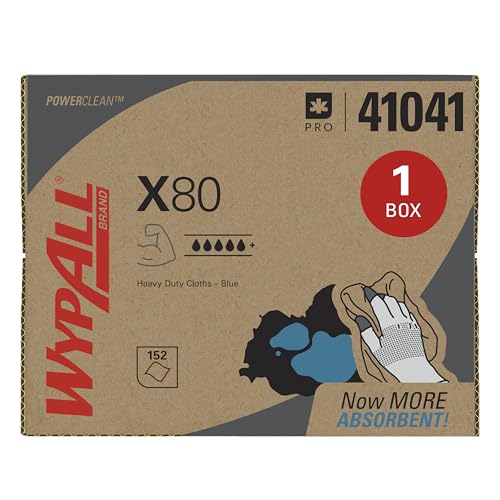
The X80 is the heavy-duty step up from a standard shop towel. Its HydroKnit material bonds soft pulp fibres to a polypropylene base sheet, and the listing positions the cloths for removing dirt, oil, grime and solvents, reinforced for strength wet and dry and durable enough for scrubbing. WypAll describes the line as extended use: a cloth can be rinsed and kept working through a session rather than binned at first heavy soil.
The Brag Box holds 152 sheets in blue, and the sheets are the largest here at 12.5 by 16.8 inches, covering a hub shell or a floor spill in fewer passes. The maker states the current X80 cloth absorbs over 20 percent more oil and up to 15 percent more water than the previous version; treat that as the maker’s comparison. The practical point: this is the disposable for scrubbing dried crud off a chainring, where a standard blue towel would be spent in two sheets.
Specs
- Brand: WypAll (Kimberly-Clark Professional)
- Model: 41041
- Type: Extended-use disposable wiper
- Material: HydroKnit, pulp fibres bonded to a polypropylene base sheet
- Format: Brag Box
- Count: 152 sheets
- Sheet size: 12.5 x 16.8 in
- Colour: Blue
3. SIMPLI-MAGIC Cotton Shop Towels, 145 Pack

This is the washable workhorse. SIMPLI-MAGIC’s pack holds 145 cotton towels at 12 by 14 inches each, built as general shop rags for automobiles, industry and garage work. Cotton drinks up oil and water, tolerates being dragged across chainrings and sprocket teeth, and goes through the machine wash to come back for another round. At 8.15 pounds, these are proper woven cloth towels rather than thin throwaway sheets.
White is a deliberate choice in a workshop rag. It shows how much filth a towel has picked up, so you know when a rag has graduated from frame duty to chain duty to floor duty, and when a towel comes out of the wash genuinely clean. Run these as the general rotation: wiping frames, drying parts, padding a frame in the stand. When one finally wears thin, it retires to floor spills.
Specs
- Brand: SIMPLI-MAGIC
- Model: 79142
- Type: Reusable shop towels
- Material: Cotton
- Count: 145 towels
- Towel size: 12 x 14 in
- Colour: White
- Care: Machine wash
- Item weight: 8.15 lb
4. Avalon Towels Cotton Shop Rags, 150 Pack

Avalon’s pack runs the same play as the SIMPLI-MAGIC with a larger count and a colour that hides the evidence. You get 150 towels of 100 percent cotton at 12 by 14 inches, sold for automobiles, industry, garage and home use, and described by the maker as absorbent all-purpose cloths for stains, spills, grease and dirt.
The green colour is the practical difference. Towels that wash in a household machine often come out still showing stains, and green reads as clean long after white has gone grey. Colour also makes rotation simple if you run two cotton packs: one colour for drivetrain work, another kept cleaner for frames and parts. There is no functional gap between this pack and the white one above; choose on count and colour.
Specs
- Brand: Avalon Towels
- Type: Reusable shop rags
- Material: 100% cotton
- Count: 150 towels
- Towel size: 12 x 14 in
- Colour: Green
- Manufacturer: Avalon Textile
5. UNIMADE Shop Towels, Microfiber, 100 Pack

Microfiber covers the clean end of the bench. UNIMADE’s pack holds 100 microfiber towels at 11.5 by 11.5 inches, sold as commercial grade work rags for automotive, mechanic and garage use, with the listing calling out lint free, highly absorbent and scratch free performance. The fine split fibres lift oil films and dust off surfaces a cotton towel would smear, and the soft face is the one to trust on paint and carbon.
Use these where the other four should not go: the final wipe of a disc rotor with solvent, cleaning seal faces during a fork service, polishing a frame, wiping down suspension stanchions. Keep the pack segregated from the general rag pile, because one trip through chain duty loads microfiber with grit and ends its career as a finishing cloth. The listing describes the towels as reusable and machine washable, and a 100 count means a clean one is always available.
Specs
- Brand: UNIMADE
- Model: UNIM-SHOPT-W100
- Type: Microfiber shop towels
- Material: Microfiber
- Count: 100 towels
- Towel size: 11.5 x 11.5 in
- Colour: White
How To Choose Between These Five
Start with the job split. If most of your wiping is drivetrain and fluid work, stock a disposable at the stand: the Scott pop-up box for everyday use, or the WypAll X80 for heavy scrubbing, when you want a sheet that survives a rinse and a second job. If you prefer to wash and reuse, the two cotton packs are interchangeable in size and role; take the white SIMPLI-MAGIC pack if you want stains visible for grading, or the green Avalon pack if you would rather they looked clean after washing. Add the UNIMADE microfiber pack alongside any of them for rotors, seals and paint.
FAQ
Should a bike workshop use disposable towels or washable rags?
Both, split by job. Disposables suit chain wiping, fluid cleanup and anything loaded with grit, because the contaminated sheet leaves with the dirt and never reaches a washing machine. Washable cotton handles general wiping, drying and padding at far less waste. A workshop that picks only one usually picks cotton for volume and keeps a box of disposables for bleeds.
How do you wash shop rags that are full of chain oil?
Shake off the loose grit first, then wash the rags as their own load in hot water with strong detergent, separate from household laundry. Very black drivetrain rags may come out clean but stained, which is fine; grade them back to dirty work. Retire any rag that still feels gritty after washing, because trapped grit scratches paint.
Are microfiber towels safe on painted frames and carbon parts?
Yes, while they are clean. The soft, fine fibres lift films without scratching, which is why the listing describes them as scratch free. The risk is not the towel but what it has picked up: once a microfiber towel has wiped a chain or a gritty floor, it holds that grit against the next surface. Keep a segregated pack for finishing work and demote used towels to general duty.
How many shop rags does a home workshop go through?
More than expected. A full drivetrain clean can spend three to five disposable sheets or two cotton towels, a brake bleed another couple, and a bike wash one or two more. That is why every pack here counts its towels in the hundreds or high dozens: a bulk pack removes the temptation to stretch one filthy rag across a whole job, which is how grit ends up in clean parts.
Conclusion
Rags are a consumable, and the bench works better when they are treated like one: plenty on hand, sorted by job, never stretched past their clean life. Keep the Scott pop-up box or the WypAll X80 Brag Box at the stand for the greasy end of the work, run the SIMPLI-MAGIC or Avalon cotton packs as the washable rotation, and hold the UNIMADE microfiber apart for the surfaces that show every mistake.
FAQ
Should a bike workshop use disposable towels or washable rags?
How do you wash shop rags that are full of chain oil?
Are microfiber towels safe on painted frames and carbon parts?
How many shop rags does a home workshop go through?
More from Amazon
Programs that pair well with the guide above. Offers and eligibility are set by Amazon and may change.
Free shipping on eligible items, Prime Video and more. Eligible new members can start with a free trial.
Start a Prime free trialA Prime membership for ages 18-24 with a trial period. Eligibility is set by Amazon.
See Prime for Young AdultsAudiobooks and podcasts to listen to on the go. Eligible new members can start with a free trial.
Try Audible freeAd-free music streaming. Eligible new subscribers can start with a free trial.
Try Music Unlimited freeAs an Amazon Associate we earn from qualifying purchases.