Key takeaways
- Find the best eyewear retainers for cycling, from cotton straps and climbing-rope cords to coated steel cables that keep sunglasses secure on every ride.
Cycling glasses live a harder life than almost any other eyewear. They get bounced on rough descents, pushed up onto a helmet at coffee stops, pulled off with one hand while rolling, and worn through sweat that makes smooth temple arms slide. A retainer is the cheapest insurance in the whole kit bag: a strap or cord that connects the two temple arms so the glasses stay on your face when you want them there, and hang safely around your neck when you do not.
As an Amazon Associate, I earn from qualifying purchases.
This guide covers five retainers that suit riding. They are all general sports retainers rather than cycling-only products — the category is sold that way — but each one names cycling, mountain biking, or active sport use in its own listing, and each solves a slightly different problem, from a soft cotton strap that disappears under a helmet to a coated steel cable that never touches your neck at all.
Why Riders Lose Glasses
Most glasses are lost or damaged in predictable moments. A pothole or a rock garden jars them down the nose until they slip off. A rider looks back over a shoulder and the movement works a loose temple arm free. Glasses pushed up onto a helmet vent fall when the rider stands to climb. And glasses hung from a jersey collar or stuffed in a pocket get crushed, scratched, or dropped at stops.
A retainer addresses all four cases. Worn snug, it holds the frame against the head so vibration and head movement cannot walk the glasses off. Worn loose, it turns the glasses into a pendant: take them off in a tunnel or at a stop and they hang on your chest instead of disappearing into a pocket full of keys and wrappers.
The Three Retainer Families
Fabric straps are the oldest design: a flat band of cotton or synthetic fabric with grippy ends that slide over the temple tips. They are soft against the neck, pack to nothing, and are the most comfortable option under a helmet because the flat band spreads pressure. Their weakness is that fabric absorbs sweat and rain, so it needs washing.
Rope cords use a round braided cord with rubber or silicone ends. They are lighter than fabric straps, dry faster, and the better ones add a sliding bead so the fit can be cinched tight for rough ground or let out for relaxed riding. The round cord can press on one spot at the back of the neck on very long rides, which is the trade for the low weight.
Cable retainers use a thin coated stainless steel cable instead of cord. The cable holds a shallow arc behind the head, so nothing rests on the neck and nothing soaks up sweat. Riders who dislike the feel of a strap usually prefer a cable, and riders who want glasses to hang low on the chest usually prefer a longer cord or strap.
What To Check Before You Order
Temple fit comes first. Every retainer grips the ends of the temple arms, and makers size those grips differently: some ends suit slim wire temples, others are bored for thick sport frames. Listings state a fit range in millimetres or describe the frames they suit, so measure the widest part of your temple tip and match it to the stated range. A grip that is too small will not slide on; one that is too large will slide off at the first bump.
Adjustability is the second check. A fixed-length retainer only hangs glasses around the neck. An adjustable one, with a sliding bead or a shortening cable, also locks the frame to the head, which is the mode that matters on descents. If you ride rough ground, treat adjustability as essential rather than a bonus.
Length is the third. Shorter retainers, around 14 inches, keep glasses high and tidy. Longer ones, up to 24 inches, let glasses hang lower and are easier to use with bulky jackets, but they swing more when you bend over the bike. Helmet fit is the last check: thin cords and flat straps sit under helmet straps and retention dials without hot spots, while thick ends can clash with low rear cradles on some helmets.
The 5 Best Eyewear Retainers For Cycling
1. Chums Original Cotton Retainer: The Soft Strap That Names Mountain Biking
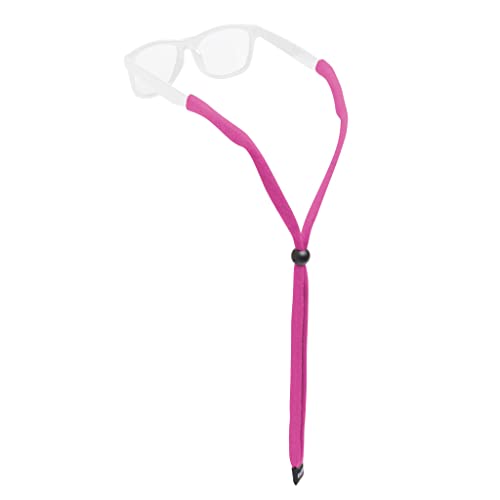
The Chums Original Cotton is the classic fabric design, and its listing is unusually direct about cycling: the maker lists mountain biking among the activities it is built for. The strap is a soft cotton band with fitted silicone tips that wrap the frame ends, and a fitted bead on a 14.5 inch loop lets you cinch it snug against the head for a descent or loosen it so the glasses hang. Cotton is the comfort choice under a helmet, it is washable when sweat builds up, and the range covers Standard, Large, Small, and Kids end sizes, so matching your temple width is straightforward.
Specs
- Model: Chums Original Cotton Retainer, Standard End
- Material: Cotton strap with fitted silicone tips
- Length: 14.5 inch loop
- Adjustment: Fitted bead, tighten or loosen the band
- End sizes: Standard, Large, Small, and Kids
- Care: Washable
- Origin: Made in the USA, per listing
2. Croakies Terra Spec Cords: Climbing Rope With A Slider Bead

Croakies builds the Terra Spec Cords from braided nylon climbing rope, a material chosen for abrasion resistance and grip. The Spec ends are the universal-fit design in the range, made to suit the widest spread of eyewear styles, and an adjustable slider bead sets the tension: loose while you read a route on your phone, pulled tight when the trail turns rough. The listing here is the 24 inch brown version, model TASC4HT, and the same cord family is offered in regular and long sizes and in adjustable and non-adjustable forms, so check the variant against the length you want before ordering.
Specs
- Model: Croakies Terra Spec Cords Adjustable, TASC4HT
- Material: Braided nylon climbing rope
- Length: 24 inches (this listing)
- Adjustment: Sliding bead for a secure fit
- Ends: Universal-fit Spec ends
- Colour: Brown (this listing)
3. Croakies ARC System: The Coated Steel Cable

The ARC System replaces cord with a coated stainless steel cable, which Croakies describes as durable and waterproof. The ends articulate, angling the cable away from your collar and off the neck, and the system is built around interchangeable ends so the same cable can grip different temple sizes. This listing is the 18 inch black version. For riders who cannot stand fabric on a sweaty neck, or who ride in rain often enough that straps stay damp, the cable format is the cleanest answer, and it shrugs off the grit that works into fabric over a season.
Specs
- Model: Croakies ARC System Eyewear Retainer
- Material: Coated stainless steel cable
- Length: 18 inches (this listing)
- Ends: Articulating, interchangeable end system
- Colour: Black (this listing)
4. Pilotfish No Tail Adjustable: The Cable That Sits Off The Neck

The Pilotfish No Tail takes the cable idea further: the cable shortens from 14 inches down to 9, so it can be pulled in until the glasses are held firmly, and the no-tail shape keeps the loop standing off the neck entirely. The ends are silicone, the cable is stainless steel, and the whole thing is aimed at active use where a dangling cord would catch or flap. This listing is the 14 inch Tactical Black version, part PFAR_TACBLACK_14. Runners and riders are the natural audience: nothing to soak, nothing to swing, and a fit that can be set once and left.
Specs
- Model: Pilotfish No Tail Adjustable Eyewear Retainer, PFAR
- Material: Stainless steel cable with silicone ends
- Length: 14 inches, adjusts down to 9 inches
- Design: No-tail, sits off the neck
- Colour: Tactical Black (this listing)
- Part number: PFAR_TACBLACK_14
5. Chums Lens Leash: The Minimal Polyester Cord

The Lens Leash is the lightest pick here at a tenth of an ounce. It is a single polyester rope cord with a dual-end cinch loop at each side: the loops adjust to grip thin frames such as small aviator arms and thick large frames alike, which removes the temple-measuring step that the other designs ask for. There is no bead and no band, just cord and loops, so it disappears in a jersey pocket or a saddle bag as a spare. For riders who want retention only when conditions demand it, and nothing around the neck the rest of the day, this is the simplest tool for the job.
Specs
- Model: Chums Lens Leash Eyewear Retainer, Classic
- Material: 100 percent polyester rope cord
- Ends: Dual-end cinch loops, fit thin to thick frames
- Weight: 0.1 ounces
- Colour: Black (this listing)
- Part number: 12104100
Fitting A Retainer So It Stays Put
Slide each end fully onto the temple arm until it seats against the widest part of the tip; a half-seated end is the usual cause of a retainer letting go. With an adjustable model, set the bead or cable so the frame feels held but the arms are not being pulled outward, which bends hinges over time. Wear the cord below the helmet’s rear cradle rather than trapped under it, and route helmet straps outside the retainer so a quick glasses removal does not drag the helmet with it.
Wash fabric straps with the rest of your kit when they stiffen with salt, and rinse cable ends after wet rides so grit does not work into the grips. Check the ends every few weeks: silicone and rubber grips age, and a loose grip replaced early is far cheaper than the glasses it was holding.
Frequently Asked Questions
Will a retainer fit my cycling glasses?
Usually, yes, provided the ends match your temple tips. Measure the widest part of the temple end and compare it with the fit range or end size in the listing. Designs with cinch loops, like the Lens Leash, cover the widest range; fixed rubber ends are the fussy ones, so match those carefully.
Can I wear a retainer with a helmet?
Yes. Thin cords and flat cotton straps sit comfortably under helmet straps and rear cradles. Cable retainers work too, and their off-neck shape avoids the bunching some riders feel with fabric. Fit the retainer first, then the helmet, so nothing is trapped in the wrong order.
Should I choose a strap, a cord, or a cable?
Choose a strap for comfort and for hanging glasses low on your chest, a cord for the lightest adjustable fit, and a cable if you dislike anything touching your neck or ride often in rain. All three hold glasses on; the difference is feel, not security, when each is fitted well.
How tight should a retainer be on a descent?
Snug enough that shaking your head does not move the frame, but not so tight that the temple arms bow outward. Adjustable beads and shortening cables exist for exactly this: loose on the climb, cinched before the rough ground, loosened again at the stop.
A retainer costs little, weighs almost nothing, and protects one of the most fragile items a rider carries. Match the ends to your temples, pick the format that suits your neck and your helmet, and the glasses you own now are the glasses you will still own at the end of the season.
FAQ
Will a retainer fit my cycling glasses?
Can I wear a retainer with a helmet?
Should I choose a strap, a cord, or a cable?
How tight should a retainer be on a descent?
More from Amazon
Programs that pair well with the guide above. Offers and eligibility are set by Amazon and may change.
Free shipping on eligible items, Prime Video and more. Eligible new members can start with a free trial.
Start a Prime free trialA Prime membership for ages 18-24 with a trial period. Eligibility is set by Amazon.
See Prime for Young AdultsAudiobooks and podcasts to listen to on the go. Eligible new members can start with a free trial.
Try Audible freeAd-free music streaming. Eligible new subscribers can start with a free trial.
Try Music Unlimited freeAs an Amazon Associate we earn from qualifying purchases.