Key takeaways
- Height (loft): The pillow should fill the gap between your ear and the mattress so your head doesn’t tilt. Side sleepers typically need 4–6 inches; back sleepers do better at 3–4.5 inches. A common mistake is buying for your sleep position but ignoring your mattress — a soft mattress lets your shoulder sink in, which effectively lowers the pillow you need.
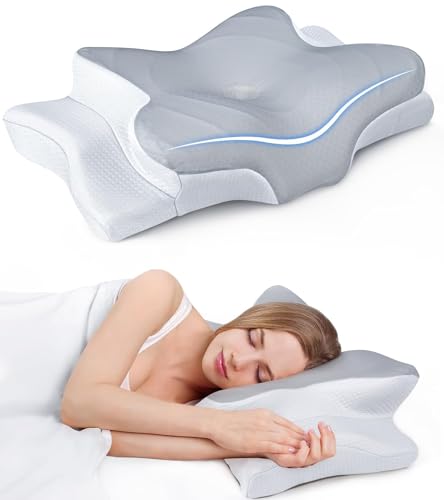
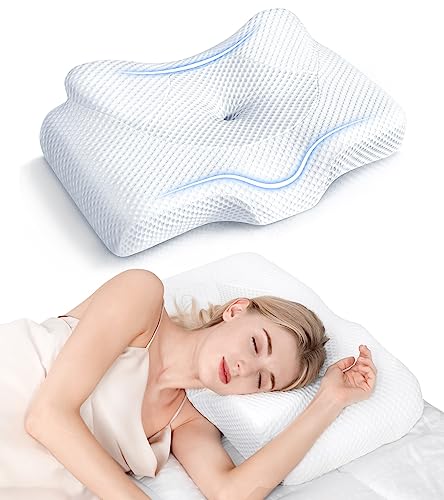
- Contour shape: Wave or butterfly contours cradle the neck’s natural curve. A flat pillow, even a firm one, can’t do this. Dual-lobe designs (a taller lobe on one side) effectively give you two pillows in one.
- Firmness: Cervical support requires firmness — a pillow that compresses flat under your head isn’t supporting anything. Memory foam is rated by density; look for 3–5 lb/ft³. Latex feels firmer and springier at equivalent support levels.
- Material and heat: Solid memory foam runs warm; shredded foam and latex sleep cooler. If you already sleep hot, this is a real durability issue too — you’ll compress and manipulate a hot pillow more, wearing it faster.
The best cervical pillows for most back and side sleepers are medium-firm memory foam or latex designs with a wave-shaped contour, roughly 4–5 inches high on the low lobe and 5–6 inches on the high lobe — but the right pick depends on your shoulder width, mattress firmness, and whether your goal is neutral spinal alignment or extra adjustability.
Our top picks


As an Amazon Associate we earn from qualifying purchases at no extra cost to you. Ratings are shown as listed on Amazon.
What Actually Determines a Good Cervical Pillow Fit
Most disappointing pillow purchases fail on one of four variables, and two of them are rarely printed prominently on the box:
- Height (loft): The pillow should fill the gap between your ear and the mattress so your head doesn’t tilt. Side sleepers typically need 4–6 inches; back sleepers do better at 3–4.5 inches. A common mistake is buying for your sleep position but ignoring your mattress — a soft mattress lets your shoulder sink in, which effectively lowers the pillow you need.
- Contour shape: Wave or butterfly contours cradle the neck’s natural curve. A flat pillow, even a firm one, can’t do this. Dual-lobe designs (a taller lobe on one side) effectively give you two pillows in one.
- Firmness: Cervical support requires firmness — a pillow that compresses flat under your head isn’t supporting anything. Memory foam is rated by density; look for 3–5 lb/ft³. Latex feels firmer and springier at equivalent support levels.
- Material and heat: Solid memory foam runs warm; shredded foam and latex sleep cooler. If you already sleep hot, this is a real durability issue too — you’ll compress and manipulate a hot pillow more, wearing it faster.
Top Cervical Pillows by Situation
Best overall for back sleepers: TEMPUR-Neck Pillow (Tempur-Pedic)
The rigid, pronounced contour of this pillow is the closest thing to a reference design in the category — it’s been sold in essentially the same form for years. It comes in three sizes (small, medium, large), which matters more than brand loyalty: the medium is roughly 4 inches at the neck lobe. The firmness is genuinely firm; people who find standard memory foam “unsupportive” usually land here. Expect a one-to-two-week break-in where it feels too stiff. Typical price range: $90–$130 depending on size.
Best adjustable option for side sleepers: Coop Sleep Goods Eden (shredded foam)
The Eden isn’t a contour pillow — it’s a shredded memory foam and microfiber pillow with a zippered inner liner, which solves the biggest fitting problem in this category: you can remove fill until the height matches your shoulder width. For broad-shouldered side sleepers on firm mattresses, most fixed-contour pillows are simply too short, and an adjustable design is the pragmatic fix. Extra fill is usually included. Price range: $85–$100.
Best budget contour: EPABO Contour Memory Foam Pillow
Dual-lobe wave contour (roughly 4.2″ low / 4.9″ high), a removable piece of foam at the base for height fine-tuning, and a breathable cover — at roughly a third of the price of the premium options. The foam is less dense than the Tempur, so it will soften and lose some contour definition sooner; figure 12–18 months of optimal support rather than 3+ years. Price range: $40–$60.
Best cooling option: contour pillows with ventilated latex or gel-infused foam
Natural latex contours (brands like Turmerry and Savvy Rest offer them) sleep noticeably cooler than solid memory foam and outlast it — latex routinely holds its shape for 4–5 years. The tradeoff is cost ($120–$180) and a springy feel that some people read as “pushing back” against the neck.
Spec Comparison at a Glance
| Pillow | Loft (low/high lobe) | Foam density | Adjustable? | Expected support life | Typical price |
|---|---|---|---|---|---|
| TEMPUR-Neck (Medium) | ~4.0″ fixed | ~5 lb/ft³, solid | No — 3 sizes sold | 3–5 years | $90–$130 |
| EPABO Contour | 4.2″ / 4.9″ | ~3 lb/ft³, solid | Yes (removable base layer) | 12–18 months | $40–$60 |
| Coop Eden | ~5″ (adjusts 3–7″) | Shredded fill | Yes (add/remove fill) | 2–3 years | $85–$100 |
| Latex contour (typical) | 4″ / 5″ | ~4.5 lb/ft³ equivalent | No | 4–5 years | $120–$180 |
Matching the Pillow to Your Situation
| Your situation | Priority | Best fit |
|---|---|---|
| Back sleeper, average build, firmer mattress | Pronounced neck cradle, lower loft | TEMPUR-Neck small/medium |
| Side sleeper, broad shoulders (over ~19″ shoulder-to-ear) | High, adjustable loft | Coop Eden with full fill |
| Switching between back and side | Dual-lobe contour | EPABO or similar wave design — use high lobe on your side, low lobe on your back |
| Sleep hot | Airflow, no solid foam | Latex contour or shredded fill |
| Under $60 | Value + removable height layer | EPABO-type budget contour |
A Simple Fit Check Before You Commit
You can estimate needed loft in two minutes: lie on your mattress in your usual position and have someone measure the gap from the mattress surface to where your ear sits with your head level. That number (typically 4–6 inches for side sleepers) is your target loft under load — and here’s the part listings don’t tell you: foam compresses roughly 20–30% under head weight. So a pillow listed at 5 inches delivers about 3.5–4 inches of real support height. Buy ~1 inch taller than your measured gap for solid foam; buy at your measured gap for firm latex.
Cost-per-use math favors the mid-range: a $95 pillow lasting 2.5 years costs about $0.10/night; a $50 pillow needing replacement at 14 months costs about $0.12/night. Cheaper isn’t always cheaper.
Ownership Realities
- What wears first: The neck lobe. Once the contour ridge no longer springs back after you lift your head, support is gone even if the pillow looks fine.
- Cleaning: Solid foam cores are spot-clean only — machine washing destroys them. Wash the cover monthly; this is where pillows actually fail hygiene-wise.
- Common mistake: Judging the pillow on night one. Cervical pillows change your sleeping posture, and an adaptation period of 1–2 weeks of mild unfamiliar discomfort is normal. Sharp or worsening pain is not — stop and reassess the height.
- Off-gassing: New memory foam smells for 24–72 hours. Air it out before first use; it’s a nuisance, not a defect.
FAQ
Can a cervical pillow fix my neck pain?
A properly fitted pillow can reduce strain from poor sleep posture, but it’s general support, not a treatment. Persistent or worsening neck pain warrants a visit to a doctor or physical therapist — the pillow decision can wait until you know what you’re dealing with.
Contour pillow or adjustable shredded pillow — how do I choose?
If you’ve already confirmed your loft need and sleep mostly in one position, a fixed contour gives more precise neck cradling. If you’re between sizes, share the pillow, or have an unusually soft/firm mattress, adjustable fill removes the guesswork.
How long should a cervical pillow last?
Budget foam: 12–18 months of peak support. Dense memory foam: 3–5 years. Latex: 4–5+ years. Replace when the contour stops recovering, regardless of the calendar.