Key takeaways
- Confusing ounces by weight with fluid ounces: Sealant dosage is normally given in fluid ounces or milliliters. A kitchen scale is not a reliable substitute unless the manufacturer provides a weight conversion.
- Treating wheel diameter as air volume: Width and sidewall height matter just as much as diameter.
- Using too little: An underfilled tire may not distribute enough sealant across the casing to seal small punctures.
- Overfilling without checking: Excess liquid adds weight and can create a mess during removal. It does not necessarily provide proportional protection.
- Mixing incompatible formulas: Latex-based sealants, aerosol products, tire slime, and emergency inflators are not interchangeable.
- Ignoring maintenance: Many bicycle sealants dry out over time. Check the liquid periodically and replenish according to the product’s guidance.
What's inside
The Short Answer
How much tire sealant you need depends on the tire’s air volume, not simply its outside diameter. As a general starting point, use about 2 to 3 fluid ounces (60 to 90 ml) for a standard bicycle tire, 3 to 4 ounces (90 to 120 ml) for a mountain-bike tire, 4 to 6 ounces (120 to 180 ml) for a fat-bike tire, and 8 to 16 ounces (240 to 473 ml) for a lawn mower, wheelbarrow, ATV, or other off-highway tire.
For a typical passenger-car tire, liquid sealant and aerosol emergency inflator are different products. A tire sealant intended for off-highway tires may require approximately 16 to 24 ounces (473 to 710 ml) per tire, while a 16-ounce aerosol such as Fix-A-Flat is generally designed as a temporary emergency repair for one standard car tire. Always follow the product label, because formulas, tire sizes, and intended uses vary.
As an Amazon Associate we earn from qualifying purchases at no extra cost to you. Product prices and availability are accurate as of the date shown and are subject to change.


The practical rule for 2026 is to buy slightly more than the exact measured requirement. That leaves enough for installation, topping off, and small spills without forcing you to mix products or run a tire below its recommended protection level.
Standard Sizes
The table below gives common starting amounts for one tire. These are useful planning measurements, not a substitute for the manufacturer’s instructions. A wider or taller tire can need substantially more product than a narrow tire on the same wheel diameter.
| Use case | Typical tire dimensions | Approximate sealant per tire | Buyer’s guide |
|---|---|---|---|
| Road or commuter bike | 700 x 25–32 mm; about 27 x 1–1.25 in | 2–3 fl oz (60–90 ml) | A 2 oz bottle may be enough for one tire; 4 oz is more convenient for a pair. |
| Gravel or cyclocross bike | 700 x 38–50 mm; about 27 x 1.5–2 in | 3–4 fl oz (90–120 ml) | Use the higher amount for tubeless tires with larger casings. |
| Mountain bike | 26–29 x 2.1–2.6 in; 66–74 cm wheel diameter | 3–4 fl oz (90–120 ml) | A 500 ml bottle, such as Stan’s NoTubes, covers roughly four to five tires at this range. |
| Plus or fat bike | 27.5–29 x 2.8–5 in; about 70–74 cm wheel diameter | 4–8 fl oz (120–240 ml) | Large-volume tires may need twice the amount of a standard mountain-bike tire. |
| Lawn mower or garden cart | 15 x 6–6 or 18 x 8.5–8 in; about 38–46 cm diameter | 8–16 fl oz (240–473 ml) | Use an off-highway formula rated for tubes or pneumatic tires. |
| ATV or utility trailer | 22–27 x 8–12 in; about 56–69 cm diameter | 16–24 fl oz (473–710 ml) | Heavy, wide casings generally require the upper end of the range. |
| Passenger car | Commonly 205/55R16 or 225/65R17; 25–29 in overall diameter | Product-specific; often 16–24 fl oz (473–710 ml) | Do not assume bicycle or mower sealant is approved for highway use. |
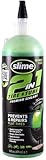
A 16-ounce bottle of Slime 10193 costs about $11.98 and is intended for non-highway tires and tubes. The 1-gallon Slime 10207 jug costs about $31.97 and makes more sense when treating several mower, ATV, trailer, or utility tires. A gallon contains 128 fluid ounces, or about 3.8 liters, so it can cover approximately eight tires at 16 ounces each, before allowing for waste.
How to Measure Your Space
Although “space” usually refers to furniture placement, tire sealant requires measuring the tire’s internal volume and checking the product’s application limits. Use this five-step process:
- Read the tire sidewall. Record the printed size, such as 700 x 40c, 29 x 2.4, 18 x 8.5–8, or 225/65R17. The first number usually identifies diameter or width, depending on the tire format.
- Identify the tire type. Determine whether it is tubeless, fitted with an inner tube, or a standard highway tire. Some sealants work in tubes and tubeless systems, while others are specifically made for bicycle tubeless setups.
- Check the recommended amount. Look on the bottle, cap, or manufacturer’s chart for the exact size range. If your tire falls between two listed sizes, use the amount for the larger size rather than guessing down.
- Convert the measurement. One fluid ounce is approximately 29.6 ml. Four ounces is about 118 ml, 8 ounces is about 237 ml, 16 ounces is about 473 ml, and 32 ounces is about 946 ml. A kitchen measuring cup marked in milliliters can help, but use a dedicated funnel or injector for installation.
- Plan for the whole set. Multiply the per-tire amount by the number of tires. For example, four 12-ounce applications require 48 fluid ounces, so a 64-ounce container is a more practical purchase than four small bottles.
Do not estimate from the tire’s outside appearance alone. Two tires marked 27.5 inches can have very different widths and internal volumes. A 27.5 x 2.8-inch tire needs considerably more sealant than a 27.5 x 1.5-inch tire.
By Room or Use Case
Road and commuter bicycles
For narrow 700c or 26-inch tires, begin with 2 to 3 ounces per tire. A 16-ounce bottle may treat roughly five to eight tires, depending on the dosage and how much remains in the applicator. Stan’s NoTubes 500 ml bottle, priced around $22, is a useful mid-size option for riders maintaining several tires. Check whether the tire and rim are tubeless-ready before adding liquid sealant.
Mountain, gravel, and fat bikes
Mountain-bike tires commonly need 3 to 4 ounces each, while gravel tires often fall between 3 and 4 ounces. Plus and fat tires can require 4 to 8 ounces because their casings hold more air. For a pair of 29 x 2.4-inch tires, 8 ounces total is a reasonable planning figure, but the label should take priority.
Lawn equipment and garden carts
Lawn mowers, wheelbarrows, hand trucks, and garden carts use much larger tire volumes than bicycles. Plan on 8 to 16 ounces per tire for many small pneumatic tires. A 16-ounce bottle may cover only one large tire, so a gallon jug is often less expensive per ounce for multiple pieces of equipment. Remove the valve core when the instructions allow it, inject the measured amount, then reinflate to the sidewall’s recommended pressure.
ATVs, trailers, and utility equipment
ATV and trailer tires can require 16 to 24 ounces per tire, with especially wide or tall tires needing more. Treat all four tires at once when possible so the vehicle has consistent protection. Use a sealant explicitly labeled for the tire type and operating conditions; bicycle formulas are not automatically suitable for heavy equipment.
Passenger cars
For a roadside emergency, Fix-A-Flat S60420 is a 16-ounce aerosol priced around $8.49. It is an inflator and temporary repair product, not the same as a long-term liquid sealant used for tubeless bicycle or off-highway tires. Follow its instructions, drive only as permitted on the label, and have the tire professionally inspected as soon as possible. Do not use an unapproved product in a highway tire or on a tire with sidewall damage.
Common Sizing Mistakes
- Confusing ounces by weight with fluid ounces: Sealant dosage is normally given in fluid ounces or milliliters. A kitchen scale is not a reliable substitute unless the manufacturer provides a weight conversion.
- Treating wheel diameter as air volume: Width and sidewall height matter just as much as diameter.
- Using too little: An underfilled tire may not distribute enough sealant across the casing to seal small punctures.
- Overfilling without checking: Excess liquid adds weight and can create a mess during removal. It does not necessarily provide proportional protection.
- Mixing incompatible formulas: Latex-based sealants, aerosol products, tire slime, and emergency inflators are not interchangeable.
- Ignoring maintenance: Many bicycle sealants dry out over time. Check the liquid periodically and replenish according to the product’s guidance.
FAQ
How much tire sealant do I need for one bicycle tire?
Use about 2 to 3 ounces for a narrow road tire, 3 to 4 ounces for a gravel or mountain-bike tire, and 4 to 8 ounces for a plus or fat-bike tire. Confirm the exact amount against the bottle’s chart.
Is 16 ounces enough for four tires?
It depends on the tire size. Sixteen ounces is enough for four narrow bicycle tires at 4 ounces each, but it is not enough for four 8-ounce mower tires. Calculate the total first and buy at least 10 percent more than the combined requirement.
Can I use bicycle sealant in a car tire?
Not unless the manufacturer specifically approves it for highway tires. Bicycle sealant is formulated for different pressures, construction, and applications. Use a product labeled for passenger vehicles and treat aerosol repair products as temporary solutions.
How often should I add more sealant?
Inspect bicycle sealant every few months, especially in hot or dry conditions, because liquid can evaporate or form a rubbery film. Add only enough to restore the recommended level. For lawn, ATV, and trailer tires, follow the product’s maintenance interval and check for leaks before each season.