Key takeaways
- Buying a wrench that maxes out at your exact spec. A 100 ft-lb maximum wrench used at 100 ft-lb is straining at its limit and loses accuracy fastest. Stay at or below 80% of the tool’s range.
- Using a 1/4-inch or 3/8-inch drive with adapters. Every adapter adds flex and error. Lug nuts need a 1/2-inch drive, full stop.
- Using the torque wrench to break loose stuck nuts. Breaking torque can exceed the spec dramatically and throw off calibration. Break nuts free with a breaker bar, then final-tighten with the torque wrench.
- Ignoring the low end of the range. A 50–250 ft-lb wrench can’t accurately set 25 ft-lb on a spare tire winch. If you do mixed work, own two wrenches or pick one starting at 10 ft-lb.
- Storing the wrench under load. Leaving the spring compressed at 150 ft-lb between uses degrades the spring and calibration. Always dial back to the lowest setting before storing.
- Trusting the impact wrench’s feel. Impact drivers don’t apply consistent torque. If you zip nuts on with an impact, always finish with a click-type wrench.
- Confusing in-lb with ft-lb. Some small wrenches read in inch-pounds. 100 in-lb equals only 8.3 ft-lb — nowhere near a lug nut spec.
What's inside
The Short Answer
For most cars and light trucks, a 1/2-inch drive torque wrench with a range of 50 to 250 ft-lb (68–340 Nm) is the right tool for wheel work. Most passenger car lug nuts specify 80–100 ft-lb (108–135 Nm), SUVs and crossovers typically call for 100–140 ft-lb (135–190 Nm), and heavier trucks can run 140–160 ft-lb (190–217 Nm). A wrench that tops out at 250 ft-lb covers all of these with room to spare, while letting you work in the middle of its range where accuracy is best.
The drive size matters as much as the torque range. A 1/2-inch drive accepts the standard 19 mm, 21 mm, and 22 mm lug sockets most wheels require, and its beefier ratchet mechanism handles high torque without flexing or failing. A 3/8-inch drive wrench can work for small cars, but it forces you to use adapters and sits near the top of its range — exactly where click-type wrenches lose accuracy.
As an Amazon Associate we earn from qualifying purchases at no extra cost to you. Product prices and availability are accurate as of the date shown and are subject to change.

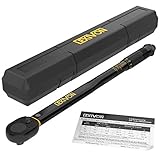
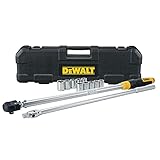

If you want a single recommendation, the LEXIVON 1/2-inch drive click wrench (LX-183) at $44.97 covers 10–150 ft-lb and handles nearly every passenger vehicle made. If you also service trucks or want headroom for stubborn fasteners, the CRAFTSMAN CMMT99434 or the DEWALT DWMT45012 12-piece kit, both spanning 50–250 ft-lb, are the safer picks.
Standard Sizes
Torque wrenches are sized by drive square (the part that accepts sockets), body length, and torque range. Here are the common formats and where each fits wheel work:
| Drive Size | Typical Range | Body Length | Body Length (cm) | Typical Weight | Best For |
|---|---|---|---|---|---|
| 1/4 inch | 20–200 in-lb (2.3–23 Nm) | 10–12 inches | 25–30 cm | 1–1.5 lbs (0.45–0.68 kg) | Not for wheels; too small for lug nuts |
| 3/8 inch | 10–100 ft-lb (13.6–135 Nm) | 15–18 inches | 38–46 cm | 2–3 lbs (0.9–1.4 kg) | Compact cars with specs under 80 ft-lb |
| 1/2 inch | 10–250 ft-lb (13.6–340 Nm) | 18–25 inches | 46–64 cm | 3–6 lbs (1.4–2.7 kg) | Cars, SUVs, crossovers, light trucks — the standard choice |
| 3/4 inch | 100–600 ft-lb (135–815 Nm) | 30–48 inches | 76–122 cm | 8–15 lbs (3.6–6.8 kg) | Commercial trucks, heavy equipment — overkill for home use |
Socket sizes matter here too. Most lug nuts use a 19 mm (3/4 inch) or 21 mm (13/16 inch) hex socket; some trucks and aftermarket wheels use 22 mm (7/8 inch). A dedicated wheel kit like the DEWALT DWMT45012 bundles the 1/2-inch drive wrench with common lug sockets in a storage case for $141.99, which saves you from buying sockets separately.
Accuracy specs fall between ±3% and ±4% for quality click-type wrenches. The Hairich 1/2-inch model ($29.99) advertises ±3% precision across a 10–170 ft-lb range, which is plenty for lug nuts — the difference between a ±3% and ±4% tool at 100 ft-lb is roughly 3 ft-lb, well within safe limits.
How to Measure Your Space
Before buying, confirm the wrench fits both your wheels and your storage situation:
- Check your lug nut torque spec. Look in your owner’s manual, on the driver’s door jamb sticker, or the wheel manufacturer’s documentation. Write down the number in ft-lb.
- Add headroom. Choose a wrench whose maximum is at least 25–50% above your spec. If your spec is 100 ft-lb, a 150 ft-lb maximum keeps you working in the tool’s sweet spot (roughly 20–80% of range).
- Verify socket compatibility. Measure your lug nut across the flats with a ruler or caliper — most are 19 mm or 21 mm. Confirm the wrench’s drive size accepts sockets you own or plan to buy.
- Measure your clearance. A 1/2-inch wrench runs 18–25 inches (46–64 cm) long. In tight wheel wells, longer wrenches can be awkward, but remember: length contributes to accuracy at high torque settings, so don’t pick a short wrench just for storage convenience.
- Plan storage. Click-type wrenches must be stored at their lowest setting with the scale dialed down. Measure your toolbox drawer or case; most 1/2-inch wrenches need at least 20 inches (51 cm) of clear length.
- Confirm recalibration access. Quality wrenches should be recalibrated every 5,000 clicks or about once a year of regular use. Check whether the manufacturer offers a calibration service or certificate.
By Room or Use Case
Passenger Cars and Sedans
Most sedans, hatchbacks, and compact SUVs specify 80–100 ft-lb (108–135 Nm). The LEXIVON LX-183 ($44.97), with its 10–150 ft-lb range, is nearly ideal — 100 ft-lb sits comfortably in the middle of its scale. The Hairich at $29.99 works too, with a 10–170 ft-lb range and ±3% claimed accuracy. Either pairs with a standard 19 mm or 21 mm 1/2-inch drive socket.
SUVs, Crossovers, and Light Trucks
Larger vehicles often call for 100–140 ft-lb. You’re now near the top of a 150 ft-lb wrench’s range, where accuracy can drift. Step up to the CRAFTSMAN CMMT99434 (50–250 ft-lb) or the DEWALT DWMT45012 kit. These keep your working spec in the lower-middle of the scale and give you headroom for truck lug nuts that spec at 140–160 ft-lb.
Trailers and Spare Tire Carriers
Trailer wheel lugs frequently spec between 90 and 120 ft-lb, and under-car spare tire winches often need far less — sometimes 25–35 ft-lb. A wrench with a low-end starting point of 10 ft-lb (like the LEXIVON or Hairich) handles the spare carrier; the same tool covers trailer lugs at mid-range.
Motorcycles and Small Wheels
Motorcycle axle nuts can spec 55–75 ft-lb, but smaller fasteners (brake carriers, sprocket bolts) run 20–45 ft-lb. A 3/8-inch drive wrench in the 10–100 ft-lb range is more appropriate here. If your torque wrench only serves motorcycle wheels, don’t buy a heavy 1/2-inch tool — you’ll sacrifice low-end resolution.
Home Garage Gift or Starter Kit Buyers
If you’re outfitting a first garage, the DEWALT DWMT45012 ($141.99) bundles a 50–250 ft-lb wrench with sockets and a case, removing the guesswork of matching components. Budget-minded buyers can pair the Hairich ($29.99) with a $20–35 socket set and cover the same ground for under $65.
Common Sizing Mistakes
- Buying a wrench that maxes out at your exact spec. A 100 ft-lb maximum wrench used at 100 ft-lb is straining at its limit and loses accuracy fastest. Stay at or below 80% of the tool’s range.
- Using a 1/4-inch or 3/8-inch drive with adapters. Every adapter adds flex and error. Lug nuts need a 1/2-inch drive, full stop.
- Using the torque wrench to break loose stuck nuts. Breaking torque can exceed the spec dramatically and throw off calibration. Break nuts free with a breaker bar, then final-tighten with the torque wrench.
- Ignoring the low end of the range. A 50–250 ft-lb wrench can’t accurately set 25 ft-lb on a spare tire winch. If you do mixed work, own two wrenches or pick one starting at 10 ft-lb.
- Storing the wrench under load. Leaving the spring compressed at 150 ft-lb between uses degrades the spring and calibration. Always dial back to the lowest setting before storing.
- Trusting the impact wrench’s feel. Impact drivers don’t apply consistent torque. If you zip nuts on with an impact, always finish with a click-type wrench.
- Confusing in-lb with ft-lb. Some small wrenches read in inch-pounds. 100 in-lb equals only 8.3 ft-lb — nowhere near a lug nut spec.
FAQ
Can I use a 3/8 inch torque wrench for wheels?
Only for small cars with lug specs under about 80 ft-lb. Most 3/8-inch wrenches top out near 100 ft-lb, so you’d be working at the extreme top of the range, and you’d need an adapter for standard 1/2-inch drive lug sockets. A 1/2-inch drive wrench is the correct tool for the job.
What torque should car lug nuts be?
Most passenger cars specify 80–100 ft-lb (108–135 Nm). Crossovers and SUVs often run 100–140 ft-lb, and full-size pickups can reach 140–160 ft-lb. Always confirm the exact number in your owner’s manual or on the door jamb sticker — alloy wheel manufacturers may publish different specs than the factory.
How accurate does a torque wrench need to be for wheels?
Within ±4% is standard and adequate; ±3% is better and common on quality wrenches. At a 100 ft-lb spec, a ±4% tool applies between 96 and 104 ft-lb — a safe spread for wheel fasteners. Avoid unbranded wrenches with no stated accuracy at all.
How often should I recalibrate my torque wrench?
Most manufacturers recommend recalibration every 5,000 click cycles or every 12 months of regular use, whichever comes first. For a homeowner rotating tires twice a year, an annual check is generous but cheap insurance. Expect professional calibration services to charge $30–75 per wrench.