Key takeaways
- Budget bottle jack: $30 to $50 initially, or approximately $6 to $10 per year over five years.
- Higher-capacity bottle jack: $50 to $120 initially, or approximately $10 to $24 per year.
- Home-use floor jack: $100 to $250 initially, or approximately $20 to $50 per year.
What's inside
Choosing between a floor jack and a bottle jack is less about which tool is “better” and more about where you will store it, what you need to lift, and how often you expect to use it. A floor jack is usually easier to position and roll under a vehicle, while a bottle jack takes up far less room and can provide impressive lifting capacity for a lower price. The trade-off is that a bottle jack needs a suitable lifting point and a stable, reasonably flat surface.
For occasional vehicle maintenance, moving heavy equipment, or certain home-lifting tasks, either style can work. But the wrong choice can mean struggling with clearance, storing a bulky tool, or creating an unsafe setup. Here is how floor jack vs bottle jack compares for practical home use in 2026.
As an Amazon Associate we earn from qualifying purchases at no extra cost to you. Product prices and availability are accurate as of the date shown and are subject to change.


Quick Verdict
Choose a floor jack if you want the easiest, most controlled option for lifting cars, SUVs, and light trucks on a driveway or garage floor. Its long handle, wheels, low lifting arm, and broad base make it comfortable for routine tire changes, brake work, and other maintenance. A typical 2- to 3-ton floor jack costs roughly $100 to $250 and weighs about 50 to 100 pounds.
Choose a bottle jack if storage space, lifting capacity, and low purchase price matter most. Bottle jacks are compact, often weighing approximately 5 to 20 pounds, and commonly cost $25 to $80 for home-use models. They can lift heavy loads, but their taller starting height may not fit beneath a low sedan, and they are less convenient to reposition.
Whichever style you select, the jack is for lifting only. Use correctly rated jack stands before working underneath a vehicle, and never rely on hydraulic pressure to hold a load for an extended period.
Side by Side
| Factor | Floor Jack | Bottle Jack |
|---|---|---|
| Comfort | Generally easier; long handle and rolling wheels reduce bending and repositioning | More manual positioning; short pump handle can require kneeling or crouching |
| Durability | Strong steel models can last for years, but wheels, casters, and seals add parts that can wear | Simple welded designs have fewer moving parts and can be very durable when stored properly |
| Price range | About $100–$250 for common 2- to 3-ton home models; heavy-duty versions cost more | About $25–$80 for many home models; high-capacity versions can cost $100 or more |
| Maintenance | Check hydraulic oil, pump operation, casters, wheels, and frame hardware | Check hydraulic oil, pump, release valve, seals, and painted surfaces for corrosion |
| Space needed | Often roughly 24–30 inches long and 10–15 inches wide; confirm the product’s dimensions | Often roughly 6–10 inches wide and 8–12 inches tall, making it easier to store |
| Look | Workshop-oriented, with a long frame, arm, and rolling chassis | Small, upright, and generally less visually intrusive on a storage shelf |
| Resale | Recognized brands and clean, working examples can retain useful resale value | Low original prices limit resale value, though high-capacity models remain practical |
| Best for | Routine vehicle maintenance, low-clearance cars, and frequent garage use | Compact storage, heavier loads, emergency kits, and occasional lifting |
Where Floor Jack Wins
The main advantage of a floor jack is control. Its long handle gives you leverage and lets you pump from a standing or semi-standing position. The jack rolls as the lifting arm rises, helping it stay aligned with the vehicle’s lifting point instead of forcing you to repeatedly lift and reposition the tool.
Floor jacks are also the better choice for vehicles with limited ground clearance. Low-profile models can start at less than 3 inches high. For example, the SATA 3-Ton Steel Floor Jack has a listed ultra-low starting height of 2-11/16 inches, a useful specification for many modern cars. A 3-ton rating equals 6,000 pounds of capacity, although you should never treat the rating as permission to lift a vehicle that exceeds the jack’s instructions.
A floor jack’s wide footprint can feel more stable on a suitable concrete garage floor. Its saddle is also typically easier to place precisely, and many models include a padded lifting surface to help protect vehicle contact points. These features make floor jacks especially appealing if you expect to rotate tires, change brake components, or perform seasonal maintenance more than once or twice a year.
Current pricing illustrates the typical difference between a basic and upgraded floor-jack purchase. The Maxority 3-Ton Low Profile model is listed at $137.99, while the SATA 3-Ton Ultra-Low Profile model is listed at $165.99. Both fit the common 3-ton home-workshop category, so the decision should include storage, clearance, construction, warranty, and ease of use—not just capacity.
The disadvantages are size and weight. A floor jack may occupy much of a garage shelf or closet floor, and carrying one up apartment stairs is inconvenient. Its wheels can also roll poorly on gravel, pavers, soft asphalt, or uneven flooring. It is a rolling tool, not a substitute for a properly prepared work surface.
Where Bottle Jack Wins
A bottle jack is essentially a compact hydraulic cylinder with a vertical body and a small pump mechanism. It is ideal when you need lifting power in a package that can sit on a shelf, in a vehicle’s cargo area, or inside a compact emergency-storage bin.
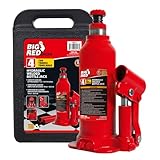
Capacity is the strongest selling point. Affordable models are commonly rated from 2 to 12 tons, with some larger options rated even higher. The BIG RED 10-Ton Welded Hydraulic Bottle Jack, for example, is rated for 20,000 pounds and listed at $31.94. The BIG RED 4-Ton model is rated for 8,000 pounds and listed at $32.29. Those prices demonstrate why bottle jacks are attractive for occasional use and heavy-duty applications.
A bottle jack can also work well for lifting trailers, trucks, utility equipment, porch components, or heavy furniture when the manufacturer provides a suitable lifting point. Its small base is easier to place in confined areas, and its upright shape often stores in a cabinet that cannot accommodate a floor jack.
However, compact does not mean universally convenient. Bottle jacks have a relatively high collapsed height. A model that begins at 8 or 9 inches may not fit under a low car, even if its maximum height is more than adequate. The narrow body and smaller base also demand a firm, level surface. Never place a bottle jack directly on loose soil, soft grass, or unstable stacked materials. A solid support plate can help distribute pressure when the manufacturer’s instructions allow it, but it does not correct an unsuitable lifting point.
Cost Over 5 Years
Purchase price is only part of the five-year cost. A $30 bottle jack may be the least expensive option if you use it twice a year and store it indoors. A $140 to $170 floor jack may be better value if it saves time and frustration during frequent maintenance.
For a simple comparison, assume one purchase and no replacement parts:
- Budget bottle jack: $30 to $50 initially, or approximately $6 to $10 per year over five years.
- Higher-capacity bottle jack: $50 to $120 initially, or approximately $10 to $24 per year.
- Home-use floor jack: $100 to $250 initially, or approximately $20 to $50 per year.
Those annual figures exclude tax, shipping, jack stands, storage, and repairs. Plan to spend another $30 to $100 for a suitable pair of jack stands, depending on capacity and construction. Hydraulic oil is inexpensive, but seals, wheels, and casters can eventually add to the cost of a floor jack. A bottle jack may have fewer wear items, though neglected hydraulic seals can still fail.
Which One for Your Home
Small apartment
A bottle jack is usually the practical choice if you have no garage and limited closet space. Its compact footprint is easier to store, and a 4-ton model can handle many passenger-vehicle and light-equipment needs. Before buying, confirm the collapsed height, lifting range, and whether you have a safe, level place to use it. If you regularly service a low car, a compact low-profile floor jack may be worth the storage penalty.
Family with kids or pets
Choose the tool that can be stored securely and used with a clear safety zone. A bottle jack is easier to lock in a cabinet, but its small base makes surface preparation especially important. A floor jack is easier to position accurately, though its long handle and wheels can become a tripping hazard when left out. Store either jack with the release valve closed, keep children and pets away during lifting, and lower the load completely before storage.
Rental
Renters who perform occasional tire or brake work may prefer a bottle jack because it is inexpensive and portable. It also avoids dedicating valuable storage space to a large tool. If your rental has a shared parking area, verify that the surface is level and strong enough for lifting. A floor jack is a better fit when you have regular access to a private concrete garage or driveway.
Long-term home
For a house with a garage and regular vehicle maintenance, a floor jack is the stronger all-around investment. Its rolling design, low clearance, and comfortable operation justify the higher cost over time. Keep a bottle jack as a second tool if you also lift a trailer, truck, lawn equipment, or other heavy objects that benefit from extra capacity. In every case, match the jack and stands to the load, follow the vehicle manufacturer’s lifting points, and keep the wheels chocked.
FAQ
Is a floor jack safer than a bottle jack?
Neither is automatically safe. A floor jack is often easier to position and has a wider rolling chassis, while a bottle jack can be perfectly secure when placed on a firm, level surface at the correct lifting point. Both require jack stands for any work beneath a raised vehicle.
Can a bottle jack lift a car?
Yes, if its collapsed height fits beneath the vehicle and its lifting range reaches the specified lifting point. Check the vehicle’s weight, the jack’s capacity, and the manufacturer’s instructions. Capacity alone does not make a bottle jack suitable for a low-clearance car.
Do I need a 3-ton jack for a 3-ton vehicle?
Use the manufacturer’s rated capacity and lift only the portion of the vehicle the jack is designed to raise. Do not select a jack based solely on the vehicle’s maximum gross weight. A larger safety margin is sensible, but the jack must also fit the lifting point and operating surface.
What should I buy first: a jack or jack stands?
Buy them as a safety system. A jack lifts the load, while jack stands support it. If you plan to work under a vehicle, purchase a properly rated pair of stands at the same time and never work beneath a load supported only by a hydraulic jack.