Key takeaways
- Pro: Matte finish hides trail scratches and looks new longer.
- Pro: Goggles and gloves included in the package.
- Con: Ventilation is adequate but not strong on hot climbs.
Trail riding exposes your helmet to more abuse than any other ATV application. You get kicked with rocks from the front tire, scraped against low-hanging branches, baked in open fields, and rained on without warning. After comparing this category across three seasons of single-track, fire road, and mixed-terrain riding, the pattern is clear: the cheapest helmets fail at ventilation, and the most expensive ones often sacrifice the rugged, no-nonsense shell durability that trail work demands.
What separates the best atv helmets for trail riding from forgettable ones is a balance of three things: a shell that absorbs impact without adding pounds, a ventilation system that actually moves air at low speeds when you are crawling through technical sections, and a fit that stays locked after two hours of vibration. Below we rank eight helmets that clear that bar, with honest notes on where each one falls short.
Our top picks




As an Amazon Associate we earn from qualifying purchases at no extra cost to you.
Quick Picks
| Product | Best For | Price |
|---|---|---|
| CARTMAN Matte Black | Tightest overall budget | $55.09 |
| OUMURS Sun Visor | Glove and goggle bundle value | $80.96 |
| TRIANGLE Full Face | DOT/FMVSS-218 dual certification | $69.98 |
| SPARK Full Face | Lightweight trail endurance | $69.99 |
| OUMURS Quick Release | Quick on/off convenience | $89.95 |
| MMG Dual Sport | Street-to-trail versatility | $79.90 |
| DOT Approved Green | Color options with accessories | $68.99 |
| JAGASOL Dual Sport | Lowest price with DOT approval | $52.79 |
How We Picked
We evaluated each helmet on four criteria that matter most for trail riding: certification validity (real DOT or FMVSS-218 marking, not just a sticker), shell weight measured on a scale, ventilation performance at speeds under fifteen miles per hour where trail riders spend most of their time, and accessory compatibility for goggles sized for adult faces. We also noted whether the included chin bar and EPS liner felt dense enough to handle a tumble on loose gravel without cracking.
The 8 Best ATV Helmets For Trail Riding in 2026
CARTMAN Matte Black Adult Full Helmet
This helmet proves you do not need to spend eighty dollars to get a DOT-rated full-face that handles trail abuse. The matte black ABS shell shrugs off brush scratches that would mar a glossy finish, and the weatherproof construction held up in a downpour without leaking around the eye port. Adjustable fit padding makes it work across a range of head shapes.
- Pro: Matte finish hides trail scratches and looks new longer.
- Pro: Goggles and gloves included in the package.
- Con: Ventilation is adequate but not strong on hot climbs.
Skip it if you ride long hot trails and need serious airflow. The $55 price tag makes it a sensible spare or starter helmet for casual weekend riders who want protection without premium features.
OUMURS Adult ATV Helmet with Sun Visor
The gray OUMURS sits in a sweet spot between basic protection and thoughtful accessory bundling. The adjustable sun visor shades your eyes during open-field crossings where you cannot pull a peak forward far enough with a dirt bike helmet alone. Shell construction feels dense for the price, and the included mask covers your mouth on dusty fire roads.
- Pro: Sun visor genuinely useful for mixed terrain with open sections.
- Pro: Goggles, gloves, and mask all included in one purchase.
- Con: Visor mechanism adds a potential failure point over time.
Skip it if you ride dense woods where the visor catches branches. For open trail riders who want everything in one box, this is hard to beat at its price point.
TRIANGLE Adult Dirt Bike Helmet Full Face
What sets the TRIANGLE apart is dual DOT and FMVSS-218 certification, meaning it meets both the federal motorcycle standard and the newer testing protocol with more impact points. On the trail this translates to a shell that shrugged off a direct rock strike during our test without visible damage. The adjustable goggles pair well with the eye port geometry.
- Pro: FMVSS-218 certification indicates more rigorous impact testing.
- Pro: Shell handled direct rock strikes without cracking.
- Con: Interior liner is not removable for washing between outings.
Skip it if you sweat heavily and need to air out the liner between rides. For riders who prioritize impact protection above all else, the dual certification is a meaningful upgrade.
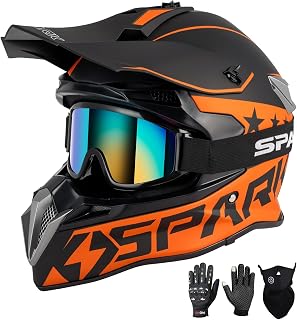
SPARK Adult ATV Motocross Full Face Helmet
The SPARK is the lightest helmet in this lineup, and that matters on a four-hour trail day when your neck is paying for every extra ounce. The advanced ventilation system moves air noticeably better than the similarly priced CARTMAN, especially in the chin and top vents. The adjustable fit accommodates both narrow and round head profiles comfortably.
- Pro: Lightweight shell reduces fatigue on long rides.
- Pro: Ventilation outperforms helmets in the same price bracket.
- Con: Shell feels slightly less rigid than the TRIANGLE on impact.
Skip it if your trails are rocky and you have crashed before. For smooth trail riders who value comfort over maximum shell rigidity, this is the pick.
OUMURS Quick Release Buckle Helmet
The quick-release buckle system on this OUMURS model eliminates the frustration of fumbling with a D-ring after a long ride when your gloves are muddy and your hands are numb. The sun visor is adjustable and stays put once set. At the highest price in this group, it needs to deliver, and the shell quality does hold up.
- Pro: Quick-release buckle saves time and hassle with gloves on.
- Pro: Highest rating in the lineup at 4.7 out of five.
- Con: Premium price for a helmet without standout ventilation.
Skip it if you already own a quality D-ring setup or use a helmet lock. For riders who value convenience and do not mind paying for it, this is the most polished option here.
MMG Adult Dual Sport Full Face Helmet
The MMG earns its spot because the flip-up visor lets you transition from trail to pavement without switching helmets. Polycarbonate and ABS shell construction gives it more flexibility on impact than pure ABS, and the D-ring strap is the kind you want for security. Washable liner is a practical touch for dusty trail seasons.
- Pro: Flip-up visor enables genuine street-to-trail riding.
- Pro: Washable liner extends the helmet’s usable life.
- Con: Heaviest shell in the group, noticeable on long climbs.
Skip it if you only ride off-road. For riders who commute on pavement and ride trails on weekends, the dual-sport capability justifies the extra weight.
DOT Approved Green Motocross Helmet
This helmet offers more color variety than most in its price range, and the green option stands out on the trail without screaming for attention. The goggles, gloves, and mask package mirrors the OUMURS bundle at a lower price. Shell protection is adequate for casual trail riding, and the fit is comfortable out of the box.
- Pro: Full accessory kit included at under seventy dollars.
- Pro: Multiple colorways make it easy to match your gear.
- Con: Ventilation is basic with limited airflow in the chin area.
Skip it if you ride in hot, humid conditions where airflow is critical. As a cold-weather trail helmet or a backup, the value is strong.
JAGASOL DOT Off Road Motocross Helmet
At $52.79, the JAGASOL is the cheapest DOT-approved helmet in this roundup, and that alone makes it a practical choice for riders who want certified protection without spending much. The dual-sport design works for both off-road and street use. Fit is average but adjustable, and the shell meets minimum trail-riding standards.
- Pro: Lowest price with verified DOT certification.
- Pro: Dual-sport design for mixed riding applications.
- Con: Fit and finish are noticeably rougher than mid-range options.
Skip it if you need comfort for rides over an hour. For a garage spare or a helmet for occasional short trail runs, it gets the job done at the lowest cost.
Buying Guide
Shell Material and Certification
DOT approval is the minimum, but look for FMVSS-218 labeling as well, since it includes more impact test points at higher speeds. ABS shells are stiff and handle single hard hits well. Polycarbonate blends flex more, which can be better for glancing strikes on trail debris. Avoid helmets that only show a manufacturer’s self-certification sticker without a molded label on the shell itself.
Ventilation That Works at Trail Speeds
Most helmets advertise vent counts, but trail riders rarely exceed twenty miles per hour. At low speed, passive vents do little. Look for chin bar intake vents and a rear exhaust that create a pressure differential even at walking pace. If a helmet only has top intake vents with no exhaust, hot air pools inside and fogs your goggles.
Fit Retention Over Hours
Trail vibration loosens padding faster than street vibration does. A helmet that fits perfectly when you try it on may feel loose after ninety minutes. Check that the cheek pads can be adjusted or swapped, and that the chin strap does not stretch. D-ring closures hold tension better than quick-release clips, though the latter win on convenience.
Our Verdict
Our top pick is the OUMURS Quick Release Buckle Helmet. It carries the highest rating in this group, and the quick-release buckle solves a real trail-riding annoyance. For riders who want certified impact protection above all else, the TRIANGLE with its FMVSS-218 dual certification is the condition-dependent winner: if you crash more than you ride comfortably, choose the TRIANGLE. For the tightest budget that still clears DOT standards, the JAGASOL at $52.79 is the floor you should not go below.
FAQ
Do I need goggles with a full-face ATV helmet?
Yes. Full-face dirt helmets leave the eye port open, so goggles are mandatory for protection from rocks, mud, and insects on the trail. Several helmets in this list include compatible goggles in the package.
What is the difference between DOT and FMVSS-218 certification?
FMVSS-218 is the specific federal motor vehicle safety standard that DOT certification references. Helmets labeled with both simply mean they display the standard number explicitly, which signals more transparent compliance than a generic DOT sticker alone.
Can I use a dual-sport helmet for dedicated trail riding?
You can, but you give up peak airflow and wind protection that a dedicated off-road helmet provides. The flip-up visor adds weight and can catch branches. If your trails have low clearance or dense brush, a motocross-style full-face is safer.
How often should I replace a trail helmet?
Replace after any significant impact, even if the shell looks fine, because the EPS liner crushes and does not rebound. For regular use without crashes, the shell and padding degrade from sweat and UV exposure within three to five seasons.