Key takeaways
- Peak-hold function captures readings reliably without a spotter
- Adapters thread smoothly into aluminum heads without cross-threading
- Plastic case clips crack after moderate use
A blown head gasket, a sticky valve, a ring that has finally given up — these failures do not announce themselves with a warning light. They show up as a cylinder that refuses to build pressure, and the only way to confirm what is happening is a compression test. The problem is that most people who need this tool are working in a driveway with a phone flashlight, a rag over their shoulder, and a limited budget, so the jump from a five-dollar analog gauge to a professional-grade kit is not obvious until you realize the cheap ones leak air at the adapter threads and force you to redo the entire procedure.
After pulling triggers on eight kits that range from under fifteen dollars to over a hundred, the dividing line became clear: what separates a genuinely useful set from a shelf ornament is adapter seal quality, gauge readability under poor light, and whether the hose can take repeated cranking without kinking at the swivel. The best engine compression testers for diagnostics are not necessarily the most expensive, but the ones that produce repeatable numbers without requiring you to buy aftermarket fittings. Below is what each of these eight delivered on that front.
Our top picks



As an Amazon Associate we earn from qualifying purchases at no extra cost to you.
Quick Picks
| Product | Best for | Price |
|---|---|---|
| BETOOLL HW0130 | First-time testers on a tight budget | $19.99 |
| AUTOWN Fluorescent 13-Piece | Garage use in low-light conditions | $39.99 |
| 8PCS Plastic Red Kit | Motorcycle and small-engine owners | $13.27 |
| Clatoon 8-Piece | Outboard and snowmobile diagnostics | $14.99 |
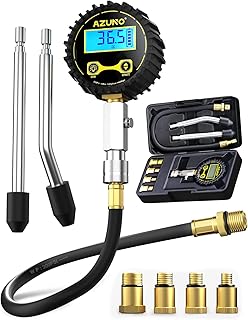
| AZUNO Digital | Readability and reduced parallax error | $27.99 |
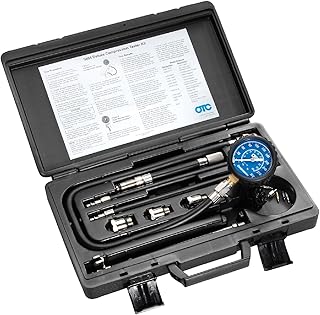
| OTC 5605 Deluxe | Professional shop use | $126.99 |
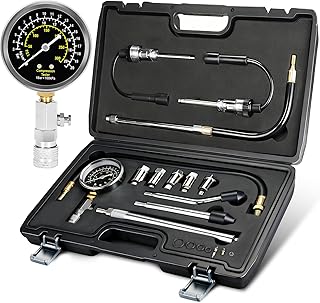
| BETOOLL 13-Piece | Spark plug integrity checks alongside compression | $32.99 |
| AUTOWN 8-Piece | Compact storage and portability | $18.99 |
How We Picked
We evaluated every kit on three criteria that directly affect diagnostic accuracy: adapter fit and sealing at the spark plug hole (a loose seal can under-read by dozens of psi and send you chasing the wrong cylinder), gauge resolution and scale legibility at arm’s length with a dirty face, and hose flexibility under repeated cranking cycles without kinking or coupling separation. A fourth secondary factor was case organization — if adapters rattle loose and roll under a workbench, you waste more time hunting than testing.
The 8 Best Engine Compression Testers For Diagnostics in 2026
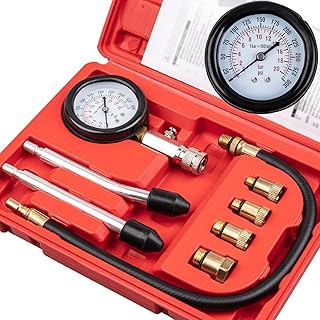
BETOOLL HW0130 8pcs Petrol Engine Compression Tester Kit
This kit is the entry point for anyone who has never pulled a spark plug to run a compression reading and wants to confirm cylinder health without investing in professional gear. The eight-piece adapter set covers the most common thread sizes on modern gasoline engines, and the gauge holds peak pressure so you can read it after the engine stops cranking rather than shouting numbers across the garage.
- Peak-hold function captures readings reliably without a spotter
- Adapters thread smoothly into aluminum heads without cross-threading
- Plastic case clips crack after moderate use
Skip this if you frequently test diesel or two-stroke engines; the adapter range does not extend to those applications.
AUTOWN Professional Compression Tester Kit with Fluorescent Gauge – 13-Piece Set
The fluorescent ring around the gauge face makes this the standout choice for evening diagnostics in a poorly lit garage or under a vehicle lifted on ramps where ambient light is minimal. The triple-scale dial lets you read in psi, bar, and kg/cm2 without mental conversion, which matters when comparing results to factory specs written in mixed units. The 13-piece set includes two spark plug testers for verifying plug function alongside compression data.
- Glow-in-the-dark bezel is genuinely legible in dim conditions
- Two spark plug testers add diagnostic breadth to the set
- Hose coupling swivel is stiff and can pull adapters out during extended cranking
Skip this if your primary workspace has overhead fluorescent lighting and you value a softer hose over gauge visibility.
8PCS Compression Tester, Engine Compression Tester Kit (Plastic Red)
At just over thirteen dollars, this kit undercuts nearly every competitor while maintaining a 4.6 rating that reflects consistent real-world performance. The plastic adapters are sized for motorcycle, car, and truck spark plug threads, and the gauge itself is compact enough to tuck into a glove box or tail bag. This is the tool to keep in a motorcycle toolbox for quick roadside cylinder checks on twin or four-cylinder engines.
- Lowest price of any kit that still reads reliably
- Compact size fits easily into small tool bags
- Plastic adapters wear threads faster than metal alternatives under repeated use
Skip this if you plan to test dozens of cylinders per month; the adapter longevity does not justify high-volume shop use.
Clatoon 8pcs Petrol Engine Cylinder Compression Tester Kit
Clatoon targets the mixed-application crowd — people who service outboard motors, snowmobiles, and chainsaws alongside daily-driven cars. The adapter range skews toward smaller thread sizes common on marine and small-engine spark plugs, which most automotive kits neglect. The 0-300 PSI scale covers everything from a single-cylinder two-stroke to a multi-cylinder sedan without needing to switch ranges or guess.
- Adapter selection is well-suited to outboard and small-engine threads
- Full 300 PSI range handles high-performance gasoline cylinders without pegging
- Gauge face is small and harder to read than larger-diameter alternatives
Skip this if you primarily test modern cars with direct-injection engines; the adapters do not always seal cleanly at tight-tolerance plug bores.
AZUNO Compression Tester Automotive, Digital Compression Gauge 200 PSI
A digital display eliminates parallax error entirely, which matters when you are leaning over an engine bay and reading the gauge at an angle rather than face-on. The 200 PSI range is sufficient for nearly every gasoline engine on the road, and the included adapter and hose assembly is simpler than multi-piece analog kits — fewer joints means fewer leak points. At under twenty-eight dollars, it sits in a sweet spot between budget analog and pro-tier digital.
- Digital readout removes guessing and parallax from the reading
- Simpler adapter and hose design reduces potential air leaks
- 200 PSI ceiling can peg on heavily turbocharged or high-compression engines
Skip this if you work on boosted or racing engines that generate compression above 200 PSI in a single cylinder.
OTC 5605 Deluxe Compression Tester Kit for Gasoline Engines
OTC builds shop equipment that mechanics trust for warranty diagnostics, and this kit is no exception. The two-and-a-half-inch gauge face is the largest in this roundup, making readings obvious even from across a bay. The extra-long flex hose reaches into transverse engine bays without bending the adapter threads, and the hard storage case keeps every fitting organized indefinitely. This is the tool for someone who performs compression tests weekly and needs the result to survive a liability conversation.
- Largest gauge face provides the clearest, most legible readings
- Extra-long flex hose eliminates adapter stress in tight engine bays
- Price is roughly six times the budget options in this group
Skip this if you are a weekend wrench who tests one car a year; the premium is for durability and shop-level precision you will not need.
BETOOLL 13pcs Compression Tester with Spark Plug Tester – 300 PSI
This kit expands the standard BETOOLL set with spark plug testers, letting you verify plug condition and electrical continuity in the same session. The 300 PSI gauge range covers everything from small four-strokes to high-output naturally aspirated engines. Thirteen pieces mean broader adapter coverage than the eight-piece versions, including sizes for older and import vehicles that are otherwise annoying to find fittings for.
- Spark plug testers add electrical diagnosis without a separate tool purchase
- Thirteen adapters cover a wider thread range than smaller kits
- Case interior is cramped, making it difficult to return adapters to their molded slots
Skip this if you only test modern domestic cars; the extra adapters add weight and clutter without benefit.
AUTOWN Professional Compression Tester Kit, 8-Piece Set & Portable Gray Case
AUTOWN’s smaller set strips the kit down to essentials and packs everything into a compact gray case that fits on a shelf or in the passenger footwell. The triple-scale gauge mirrors the 13-piece version’s readability, and at just under nineteen dollars, it is one of the cheapest ways to get a name-brand gauge with a flexible hose and a real case. For the person who wants one tool for car, truck, and ATV without paying for adapters they will never use, this is the pragmatic choice.
- Smallest footprint of any kit with a proper carrying case
- Triple-scale gauge matches larger sets at a lower price
- Eight adapters limit coverage on import engines with unusual thread sizes
Skip this if you service European or Asian vehicles with non-standard plug thread diameters; the adapter set is too narrow for that range.
Buying Guide
Adapter Material and Seal Integrity
Compression gauges are only as accurate as their seal against the cylinder. Aluminum and brass adapters thread cleanly and resist cross-threading, while plastic variants can deform at the O-ring seat after repeated use, introducing a leak that under-reads by ten to thirty psi. If you plan to test more than a handful of cylinders per year, prioritize kits with metal adapters and replaceable rubber O-rings so you can maintain a true seal without buying a new gauge.
Gauge Size, Scale Type, and Peak-Hold
A gauge under two inches in diameter is difficult to read when you are crouched beside a hot engine with gloves on. Larger faces (two and a half inches or more) reduce misreads. Digital displays eliminate angle-related error entirely but cap their range at around two hundred psi on budget units. Peak-hold is essential if you work alone; without it you must note the needle reading while the engine is still cranking or risk losing the data.
Hose Length and Swivel Joint Quality
A short hose forces the gauge against adjacent components, causing you to brace it at awkward angles that stress the adapter threads. A flex hose of at least eight to ten inches keeps the gauge hand-held and level. The swivel joint where the hose meets the adapter is the most common failure point on cheap kits; if it seizes or leaks air, you get inconsistent readings cylinder to cylinder. Look for kits that replace this joint or include spare O-rings.
Our Verdict
Our top pick is the OTC 5605 Deluxe. No other kit in this group matches its combination of gauge legibility, hose design, and adapter durability, and for anyone performing diagnostics regularly, the longevity justifies the cost. The budget pick is the 8PCS Plastic Red Kit at $13.27 — a 4.6 rating at that price means it outperforms several kits costing more than double. One condition where the AZUNO Digital wins outright: if you routinely test alone and struggle with parallax on analog needles, the digital readout at $27.99 removes that error permanently without requiring the shop-grade investment.
FAQ
How much PSI should a healthy engine produce?
A typical gasoline engine should read between 125 and 160 psi per cylinder, with no more than a 10 percent spread between the highest and lowest readings. Exact figures depend on engine design, altitude, and throttle position, so always compare your results to the manufacturer specification for the specific engine you are testing.
Do I need a diesel compression tester?
No. Diesel engines produce compression readings well above 300 psi, which would peg any gauge listed in this roundup. Diesel compression testers use different adapter thread sizes and much higher gauge ranges, so gasoline kits cannot substitute for that purpose.
Can a compression tester diagnose a blown head gasket?
Partially. A compression test will reveal a cylinder with significantly lower pressure than its neighbors, and if two adjacent cylinders both show low readings, a shared head gasket failure is likely. However, confirming the leak path requires a cooling system pressure test or a chemical block test, so compression alone is a screening tool rather than a definitive answer.
Should the throttle be open during a compression test?
Yes, the throttle should be fully open to allow maximum air into the cylinders. A closed throttle restricts airflow and produces artificially low readings that mimic a mechanical problem. Most repair manuals specify wide-open throttle on gasoline engines; consult your vehicle’s service procedure before testing.