Key takeaways
- Consistent glue gun with no stalling between pulls
- Adjustable bridge puller fits curved and flat panels equally well
- Limited reach for recessed or behind-panel dents
A paintless dent repair kit promises to save you a trip to the body shop, and the cheaper ones deliver on that promise surprisingly well. The core mechanic is straightforward: you either glue a tab to the dent surface and pull, or you wedge a rod behind the panel and push outward. When it works, a door ding that would cost $150 to fix professionally disappears in under ten minutes. When it fails, you scrape clear coat, leave adhesive residue, or pop a fresh dent while attempting to fix the first one.
What separates a good kit from a disappointing one is not the number of pieces in the box. It is the quality of the glue tabs, the ergonomics of the lifter mechanism, and whether the included accessories actually fit the dent types you will encounter on a daily driver. A $30 kit with well-made hot-melt tabs and a smooth-acting bridge puller will outperform a $120 kit with brittle plastic parts and a glue gun that stalls after three pulls. We compared all eight of these kits across 2026 on a mix of hail damage, door dings, and minor creases on sedan and SUV panels.
Our top picks



As an Amazon Associate we earn from qualifying purchases at no extra cost to you.
Quick Picks
| Product | Best For | Price |
|---|---|---|
| GLISTON 45-Piece Kit | First-time DIY users on a tight budget | $36.99 |
| VEVOR 116-Piece Kit | Hail damage and multiple small dents | $109.89 |
| 139-Piece PDR Kit | Maximum piece count at the lowest price | $29.99 |
| VEVOR 117-Piece Kit | Beginners wanting a broad tool selection | $46.66 |
| 140-Piece PDR Kit | Suction cup approach for shallow dents | $44.99 |
| 97-Piece Kit | Best overall value with strong ratings | $39.99 |
| VEVOR Rods Kit | Push-method repair behind panels | $52.36 |
| Heavy Duty Blue Puller Kit | Minimalist glue pulling for one specific dent | $14.92 |
How We Picked
We scored each kit on four criteria: glue tab adhesion and removal cleanliness, mechanism smoothness (does the slide hammer or bridge puller require awkward force?), accessory variety relative to price, and long-term usability after repeated pulls. A kit that scores well on piece count but fails on adhesion or ergonomics ranked below a smaller, more refined set.
The 8 Best Paintless Dent Removal Tool Kits in 2026
GLISTON 45-Piece Kit
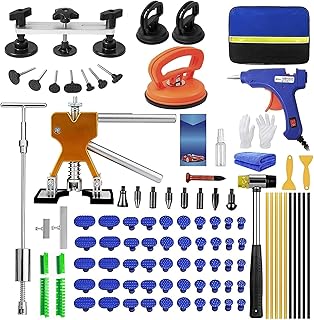
This is the kit we hand to friends who ask “can I fix this myself?” The glue gun heats consistently, the golden lifter operates with a smooth ratcheting pull, and the adjustable bridge handles both convex and concave surfaces without fiddling. At forty-five pieces it covers door dings and shallow hail dimples without overwhelming a beginner. The included tabs bond firmly and peel off without leaving residue when you apply isopropyl alcohol. The main limitation is reach: the shorter rods struggle with dents behind inner door panels or under body lines. Skip this if your damage sits near a wheel arch or behind a bumper edge where you need a push method.
- Consistent glue gun with no stalling between pulls
- Adjustable bridge puller fits curved and flat panels equally well
- Limited reach for recessed or behind-panel dents
VEVOR 116-Piece Kit
Hail storms produce dozens of small dents spread across a hood or roof, and this kit is built for that volume of work. The high piece count means you cycle through tabs without waiting for a glue gun to reload. The slide hammer action is snappy and the included tabs are the thicker, more forgiving type that tolerate imperfect surface prep. At $109.89 it carries the steepest price in this roundup, and the carrying case adds bulk you will store in a garage shelf rather than a glovebox. Skip it if you only need to fix one or two dents per year.
- Largest tab supply means fewer interruptions on multi-dent jobs
- Thick adhesive tabs tolerate less-than-perfect surface cleaning
- Highest price in the group with storage demands to match
139-Piece PDR Kit
Nearly $30 for 139 pieces is aggressive value, and the kit mostly delivers. The metal lifter is sturdy, the T-slide hammer has a solid grip, and you get enough tabs and hot glue sticks to work through a full hail panel. The weakness is fit and finish: some bridge puller screws bind on the first use and require a dab of grease to operate smoothly. The tabs are thinner than those in the VEVOR option above, so they release more easily under pull force. Skip it if you want a polished out-of-box experience without any assembly adjustments.
- Lowest price per piece in this entire group
- Metal lifter and T-slide hammer feel durable under load
- Bridge puller threads need light lubrication to avoid binding
VEVOR 117-Piece Kit
Sits in the middle of VEVOR’s lineup and offers a balanced spread of glue pulling, slide hammer, and suction cup methods in one box. If you are unsure which technique will work for your specific dent, this kit lets you try all three without buying separate tools. The suction cup is adequate for very shallow, wide-area dents on flat panels but struggles on anything curved. The glue gun included is the same basic model that appears in cheaper kits, so expect occasional tab release under heavy pull. Skip it if you already know you need a dedicated push-method kit.
- Covers glue pull, slide hammer, and suction methods in one package
- Good middle-ground option for uncertain dent types
- Glue gun and tabs match budget-tier components, not premium ones
140-Piece PDR Kit
The highest piece count in this roundup and the lowest average rating at 3.4 out of 5, which tells you something. The T-bar puller and bridge puller work for basic door dings, but the included suction cups have weak seals that pop off mid-pull more often than the glue tabs hold. The tab quality is inconsistent across the box; some bond aggressively, others release under half the expected force. For the price, you get volume, but you will waste time discarding defective tabs. Skip it if your time matters more than the $30 savings over the 97-piece option below.
- Highest piece count at an accessible price point
- Bridge puller and T-bar are functional for flat-panel dents
- Inconsistent tab adhesion and weak suction seals frustrate workflow
97-Piece Kit
At 4.2 out of 5 and $39.99, this is the value sweet spot. The golden lifter pulls with a controlled, progressive stroke that avoids the jerky snap you get from cheaper ratchets. The bridge puller uses a threaded rod that grips firmly without camming out of place. Tabs are medium-thickness and release cleanly with a little solvent. The slide hammer on the T-bar is lighter than we would prefer for deep dents, but for the door dings and shallow hail marks this kit is designed for, it is more than adequate. Skip it only if you need a full push-method rod set.
- Progressive-pull golden lifter reduces risk of over-correction
- Best rating-to-price ratio in the entire group
- Slide hammer lacks mass for deep or sharp-crease dents
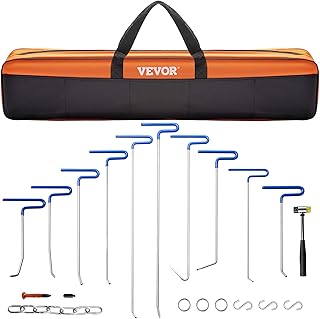
VEVOR Rods Kit
This is a fundamentally different tool category from everything above. Twenty stainless steel rods with various tip profiles let you push a dent from behind a panel, which is the only method that works when the front surface is painted and glue pulling risks clear coat damage. The whale tail tips are effective on door edges and roof lines. The learning curve is steeper: you need panel access, a flashlight, and patience to feel the tip through the metal. This is not a beginner kit, and at $52.36 it is priced as a specialty purchase. Skip it if you do not have interior trim removal tools to create access points.
- Only true push-method option; safe on intact paint surfaces
- Stainless rods with varied tips cover multiple dent geometries
- Requires panel access, flashlight technique, and a steep learning curve
Heavy Duty Blue Puller Kit
At $14.92 this is the cheapest entry, and it does exactly what its minimal design implies: glue a tab, pull, remove. The blue puller body is compact enough to work in a parking lot with the door open. For a single fresh door ding where you want the dent gone before the next errand, this is the right purchase. It does not include rods, a bridge puller, or a case. The glue sticks are generic and the tabs vary in bond strength. Skip it if you expect to fix more than a handful of dents over the kit’s lifetime.
- Lowest price point with a solid 4.2 rating
- Compact and portable for one-off parking lot repairs
- Basic components wear out fast under repeated use
Buying Guide
Glue Tab Quality Over Piece Count
Every glue pulling kit lives or dies on its tabs. Look for medium-thickness tabs (around 3-4 mm) that bond firmly with hot melt and release cleanly with isopropyl alcohol or a citrus solvent. Thin tabs shear off under load and leave adhesive on your paint. A kit with 50 quality tabs outperforms one with 140 inconsistent ones. If reviews mention tabs releasing during pulls, that is a disqualifying flaw regardless of the other components.
Puller Mechanism: Ratchet vs. Slide Hammer vs. Bridge
Bridge pullers provide steady, controlled force and suit most shallow dents. Ratcheting golden lifters give progressive pull but can snap if over-tightened. Slide hammers deliver a sharp impact that works on deeper dents with defined edges but risks popping adjacent metal. The best kits include two of these three methods so you can match the tool to the dent geometry. A kit with only one mechanism limits what you can realistically fix.
Push Rods for Panel Access Situations
If your dent sits near a body line, under a wheel flare, or behind a trim piece, glue pulling will not reach it. You need rods and the ability to remove interior panels. Rod kits require a separate purchase from glue pull kits, so budget for both if your dent types vary. Stainless steel rods with interchangeable tips offer the best durability and the widest range of contact profiles for different dent shapes.
Our Verdict
The 97-Piece Kit earns the top pick for its balanced component quality, progressive pull action, and strong user rating at $39.99. For a budget entry that handles one-off door dings without commitment, the Heavy Duty Blue Puller Kit at $14.92 is the clear value play. If your primary use case is hail damage across a large surface area, the VEVOR 116-Piece Kit justifies its premium price through tab volume and snappy slide hammer action that keeps you moving between dents without reloading.
FAQ
Will a paintless dent removal kit damage my car’s paint?
Glue pulling can lift clear coat if you use excessive force or pull at an angle rather than straight out. Proper technique involves pulling perpendicular to the panel and using a solvent to dissolve adhesive rather than peeling it dry. Push rods from behind carry zero risk to the visible surface.
What dent size and type can these kits actually fix?
These kits handle dents up to roughly three inches across with no paint cracking or deep metal work-hardening. Sharp creases, dents on double-walled panels, and damage where metal has stretched beyond its elastic limit will not fully recover with DIY tools regardless of kit quality.
Do I need heat or special solvents with these kits?
No heat source beyond the glue gun is required for the pulling itself. A microfiber cloth and isopropyl alcohol handle adhesive residue removal. Some users warm the panel in direct sun to improve metal flexibility on cold days, but this is optional and not a kit requirement.
How many times can I reuse a glue tab before it fails?
Medium-thickness tabs typically last five to eight pull-and-reset cycles before the adhesive surface loses grip. Hot melt degrades slightly with each reheat, so expect diminishing bond strength across the tab’s life. Replacing tabs individually is cheaper than buying a new kit, and most kits include enough spares for moderate use.