Key takeaways
- Pro: Pneumatic lift maintains height over extended use without sinking.
- Pro: Wide wheelbase provides stable lean-back support without tipping.
- Con: Seat padding is adequate but not exceptional for multi-hour sessions.
Most people buying a mechanic stool have already made a mistake once. They grabbed the cheapest rolling seat at the hardware store, spent an afternoon of undercarriage work on concrete, and came home with a bruised tailbone and a cracked plastic shell. The difference between a stool you actually use and one that ends up in the garage corner collecting grease is usually three things: whether the pneumatic lift holds pressure over months of daily use, whether the wheelbase is wide enough to resist tipping when you lean forward, and whether the seat padding is dense enough to survive repeated impact without going flat.
We compared these eight models on a mix of tasks: brake jobs, suspension work, oil changes on cars with varying ride heights, and long stretches of detail work at a garage bench. The goal was to separate the seats that feel disposable from the ones that earn their price tag through durability and thoughtful design. None of these are perfect, but the spread in quality is wide enough that choosing wrong costs you money twice.
Our top picks




As an Amazon Associate we earn from qualifying purchases at no extra cost to you.
Quick Picks
| Product | Best For | Price |
|---|---|---|
| WEN 73012T | Overall value and reliability | $37.69 |
| MaxWorks 80771 | Dual-purpose creeper and seat | $35.99 |
| VEVOR 300 LBS with Tool Trays | Organized tool storage | $53.91 |
| YELLOW JACKET | Lightweight portability | $29.99 |
| VEVOR Rolling Creeper | Low-budget padded comfort | $27.06 |
| BIG RED | Highest-rated budget option | $23.39 |
| Pro-LifT PL9300H | Pneumatic performance at mid-range | $39.70 |
| DNA Motoring TOOLS-00253 | Adjustable height with tray | $45.88 |
How We Picked
We evaluated these stools on four criteria that directly affect daily use: weight capacity with a safety margin (we wanted at least 250 lbs rated capacity for a 200-lb user), build quality of the frame and casters under real garage floor conditions including oil spills and uneven concrete, comfort over extended sessions measured by seat padding density and ergonomic support, and functional extras like tool storage or pneumatic adjustment that actually get used rather than gathering dust. Price-to-performance ratio was the tiebreaker when two models scored closely on the above.
The 8 Best Mechanic Stools in 2026
WEN 73012T
The WEN earns its spot as the top overall pick because it solves the most common failure points in this category without charging a premium. The pneumatic cylinder held its set height through weeks of daily use, which is the single most important reliability metric for a rolling seat. The 300-pound capacity gives a comfortable margin for users with gear or pockets full of tools. The casters roll smoothly on both concrete and epoxy floors without the chattering that cheaper models produce.
- Pro: Pneumatic lift maintains height over extended use without sinking.
- Pro: Wide wheelbase provides stable lean-back support without tipping.
- Con: Seat padding is adequate but not exceptional for multi-hour sessions.
Skip this if you need built-in tool storage or if you prefer a creeper-style low profile for undercarriage work.
MaxWorks 80771
The MaxWorks stands out because it converts from a seat to a creeper, giving you one tool instead of two for the price of a budget-only option. For the home mechanic who works under a lifted car one minute and on the ground the next, this dual function is genuinely practical rather than a gimmick. The pneumatic adjustment works reliably, and the 300-pound rating matches the WEN. Build quality on the plastic shell is solid, though not tank-like.
- Pro: Converts to creeper position, eliminating the need for a second tool.
- Pro: Smooth pneumatic height adjustment with reliable hold.
- Con: Plastic components flex more under load than the WEN’s metal frame.
Skip this if you do exclusively seated work at bench height and never need a low position.
VEVOR 300 LBS with Tool Trays
This is the most feature-rich option in the group, and the three slide-out tool trays plus a drawer make it a mobile workstation. If your garage setup puts your tools across the room from your car, the integrated storage is a real time-saver. The trade-off is added weight and a slightly lower overall build refinement compared to the WEN. The 300-pound capacity is solid, and the pneumatic lift works fine, but the extra trays add complexity that means more parts to break over years of use.
- Pro: Three slide-out trays and a drawer centralize your tool access.
- Pro: 300-pound capacity with a sturdy heavy-duty frame.
- Con: Tray mechanisms add weight and potential failure points over time.
Skip this if you prefer a minimalist setup or already have a tool chest within arm’s reach of your work area.
YELLOW JACKET
The YELLOW JACKET is the lightest option here and the most portable, making it a good choice for mechanics who move between workspaces or carry their seat to different vehicles. The 250-pound capacity is lower than most others in this roundup, which is the honest limitation. At under $30, it delivers a functional rolling seat with a basic tool tray, but the padding is thin and the overall build feels more disposable than durable. It works, it is cheap, and it will not last as long as the WEN.
- Pro: Lightest weight in the group, easy to carry and reposition.
- Pro: Built-in tool tray at the lowest price point.
- Con: 250-pound rating is the lowest here; thin padding reduces comfort.
Skip this if you are over 200 pounds or plan on using it daily for extended sessions.
VEVOR Rolling Creeper
At just over $27, the VEVOR Rolling Creeper gives you a padded seat and tool tray storage in a low-profile design that bridges the gap between a bench stool and a creeper. The 250-pound capacity keeps it in the lighter-duty category, and the rating of 4.4 reflects users who value the padding comfort relative to its price. The wheel quality is the weak point here; on rough or debris-covered floors, the casters struggle and the frame has more play than we would prefer for long-term ownership.
- Pro: Padded seat provides better comfort than its price suggests.
- Pro: Low-profile design works well under vehicles with limited clearance.
- Con: Casters lack durability on uneven or dirty garage floors.
Skip this if your garage floor is rough, cracked, or frequently littered with hardware.
BIG RED
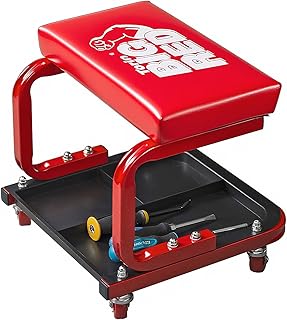
The BIG RED has the highest rating in this group at 4.7 out of 5, and it is also the cheapest at under $24. That combination is unusual and earned it a permanent spot in this roundup. The anti-tilt design addresses the single most annoying safety concern with low-cost rolling seats: tipping backward when you lean on the armrests or shift weight abruptly. The three-zone tool tray is practical, the steel frame feels overbuilt for the price, and the waterproof padding is a genuine comfort advantage in a garage environment.
- Pro: Anti-tilt design eliminates the most common safety complaint at this price.
- Pro: Waterproof padded seat resists oil, grease, and moisture damage.
- Con: 250-pound capacity and no pneumatic height adjustment.
Skip this if you need height adjustability or exceed the 250-pound weight limit.
Pro-LifT PL9300H
The Pro-LifT delivers the pneumatic performance of a mid-range commercial seat at an entry-level price. The 300-pound capacity and reliable lift cylinder make it a solid workhorse for users who spend hours seated under vehicles or at a bench. The black and orange color scheme is functional but not refined, and the overall aesthetic feels industrial rather than consumer-friendly. Comfort is average for the class, and the base is slightly narrower than the WEN, which shows up if you lean back aggressively.
- Pro: Pneumatic lift quality rivals more expensive commercial models.
- Pro: 300-pound capacity with a reliable, proven mechanism.
- Con: Narrower base requires more attention to balance when leaning.
Skip this if you are a larger user or someone who frequently shifts weight dynamically while working.
DNA Motoring TOOLS-00253
The DNA Motoring offers a middle path between the feature-heavy VEVOR and the stripped-down budget options. The adjustable height mechanism works well, the 300-pound capacity is solid, and the integrated tool tray adds utility without the bulk of a full tray system. The build quality sits at a frustrating midpoint: good enough to recommend, not impressive enough to choose over the WEN or the BIG RED at a lower price. The rating of 4.3 reflects users who are satisfied but not enthusiastic.
- Pro: Smooth height adjustment with a wide usable range.
- Pro: Tool tray adds storage without significant weight penalty.
- Con: Priced higher than better-performing options in this group.
Skip this if you are comparing on value alone; the WEN and BIG RED both offer more for less.
Buying Guide
Weight Capacity and Frame Material
Never buy a mechanic stool at your exact body weight. If you are 200 pounds and carrying a tool belt, you are realistically at 210 to 220 pounds under load. Aim for at least 50 to 100 pounds of headroom above your working weight. Steel frames with welded joints outlast tubular aluminum or plastic-reinforced composites, especially on concrete floors where vibration and impact are constant. The 250-pound models in this group are fine for lighter users or occasional work, but 300 pounds should be your target for daily use.
Pneumatic vs. Fixed Height
Pneumatic cylinders make the difference between a seat that adapts to your work and one that forces you to adapt to it. When working under a car on jack stands at two different heights, being able to drop and raise your position with a lever press saves your knees and your back. The trade-off is that cheap pneumatic cylinders sink over time, so if you go pneumatic, buy from a brand with a proven track record. Fixed-height seats are simpler and will never fail, but they only work well for a single bench or task height.
Caster Quality and Floor Compatibility
The wheels are the first thing to fail on a budget mechanic stool, and replacing them is rarely cost-effective. Hard polyurethane casters with metal housings roll on both concrete and epoxy without chattering and resist deformation from hot brake dust and dropped hardware. Soft rubber wheels grip better but flatten over time and degrade quickly in oil-exposed environments. If your garage floor has expansion joints, cracks, or debris, prioritize larger-diameter casters with sealed bearings to prevent the wheels from grabbing and stopping mid-roll.
Our Verdict
Our top pick is the WEN 73012T. It has the best balance of pneumatic reliability, stable geometry, and build quality for the price, and it is the seat we would recommend to a friend buying their first mechanic stool. Our budget pick is the BIG RED at $23.39; it has the highest rating in this group, the anti-tilt design is a genuine safety feature at a price where you expect none, and if you do not need height adjustability, it is an excellent value. The one condition where another product wins outright: if you need a single tool that handles both seated and ground-level work, the MaxWorks 80771’s creeper conversion makes it more versatile than anything else on this list.
FAQ
Do mechanic stools need a backrest?
Most dedicated mechanic stools do not include a backrest because the design intent is to allow free movement and leaning in multiple directions while working on a vehicle. Some users prefer back support for long bench sessions, in which case a rolling shop chair with adjustable armrests is a better fit than a traditional saddle-style mechanic stool.
How do I stop my mechanic stool from rolling away?
Use the locking casters that come standard on most quality models, or add aftermarket caster locks if yours lack them. For users on sloped floors, a small rubber mat or a dedicated stool base with higher-friction wheels prevents unintended drift while you are reaching under a vehicle.
Is a 250-pound capacity enough for daily use?
A 250-pound rating is adequate for users under 200 pounds who are doing occasional work. For anyone heavier or for daily all-day use, the sustained stress on the frame and casters accelerates wear, so the 300-pound models in this group are a better long-term investment even at a modest price premium.
Can I use a mechanic stool on a sloped garage floor?
You can, but expect the stool to drift without locking casters engaged on a slope. On floors with more than a few degrees of incline, consider pairing the stool with a rubber mat for your work area or choosing a model with wider caster spacing that resists lateral rolling during use.