After spending weeks pulling borescopes out of engine bays, threading them through drain lines, and propping them inside HVAC ductwork, I can tell you this category is deceptively hard to shop for. The problem is simple on the surface: you need to see where your eyes and hands cannot reach. But the gap between a scope that actually helps you diagnose a cracked cylinder wall and one that gives you a blurry, dim, pixelated mess is enormous — and price alone does not predict which side of that gap you land on.
What separates the best inspection borescopes from mediocre ones in 2026 comes down to a few non-negotiables. Articulation that holds its position under tension. Screen brightness that does not wash out under a shop LED or direct garage sun. Probe diameters slim enough to fit past sensor ports and spark plug holes. And cable construction that does not kink or twist the moment you push it through a tight elbow. The eight picks below cover a realistic spread of budgets and use cases, from quick DIY jobs to daily professional work.
Our top picks


As an Amazon Associate we earn from qualifying purchases at no extra cost to you.
Quick Picks
| Product | Best for | Price |
|---|---|---|
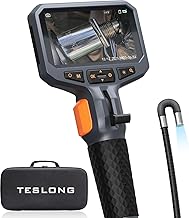
| Teslong Articulating Borescope | Pros who need two-way articulation with a standalone screen | $103.99 |
| Endoscope Camera with Light (Dual-Lens) | Plumbers and sewer inspection on a tight budget | $29.99 |
| Endoscope Camera 1920P HD (16.5FT) | DIYers who want no-app simplicity | $37.99 |
| FOXWELL Y400 | Tight-space engine work with an ultra-slim probe | $109.99 |
| Endoscope Camera 1920P Dual-Lens (iOS/Android) | Users who prefer a phone-based display | $40.99 |
| Anykit 210° Articulating | Mechanics who want slim probe plus articulation | $71.99 |
| Kinpthy Endoscope Camera (Single Lens) | Entry-level auto and wall inspection | $30.99 |
| Teslong 5″ Dual Lens | Heavy-duty multi-use with maximum screen size | $135.99 |
How We Picked
I evaluated every unit against four criteria that directly affect real-world usability: image clarity and low-light performance, probe articulation and diameter, display quality versus phone-reliance, and build durability including waterproofing and cable memory. I also weighed standalone screen convenience against the flexibility of phone-connected models, because a cracked phone screen mid-diagnosis is not something you want to deal with on a busy lift. Every product here scored at least 4.3 out of 5 across verified user reviews.
The 8 Best Inspection Borescopes in 2026
Teslong Articulating Borescope
This is the one I reach for when a job demands precision viewing without a laptop or phone tether. The 2.0MP sensor and 8 LED lights deliver a bright, usable image on the 4.5-inch IPS screen, and the two-way 210-degree articulation actually holds its angle when you push the semi-rigid gooseneck through tight bends. IP67 rating means it survives fuel-dunk tests and wet exhaust work without hesitation. The 32GB onboard storage is a quiet luxury for anyone who needs to log findings for a customer. It is heavier than phone-based options, and the carrying case adds bulk to a already crowded tool chest. Skip it if you primarily inspect deep sewer lines — the cable length is better suited to automotive and HVAC distances.
Endoscope Camera with Light (Dual-Lens)
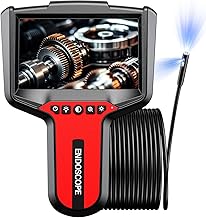
At under $30, this dual-lens scope with a 5-inch 1080P screen and 16.4 feet of waterproof cable is absurd value for sewer and plumbing work. The 16.4-foot reach gets you past typical P-traps and into main line territory without splicing. For automotive use, the dual lens lets you flip between front and side views, which helps in confined engine compartments. The build feels plasticky and the LED array dims noticeably after twenty minutes of continuous use. Skip it if image fidelity matters for professional diagnostics — the 1080P resolution here is adequate for spotting blockages, not hairline cracks.
Endoscope Camera 1920P HD (16.5FT)
No-app operation is the headline here, and for many DIYers that is the entire reason to buy this unit. You get a 4.3-inch IPS screen with 1920P capture, 8 LED lights, and IP67 waterproofing in a package that works straight out of the box. The 16.5-foot cable handles most residential plumbing and automotive inspection distances. The semi-rigid snake does not articulate, which limits its usefulness in corners — you rely on cable bending alone to change viewing angle. Skip it if you work around HVAC ductwork or engine blocks where you need to look sideways without twisting the whole probe.
FOXWELL Y400
The 0.24-inch ultra-slim probe is the reason this earns a spot over more expensive units. It fits through spark plug ports, O2 sensor holes, and narrow drain fittings that swallow thicker probes entirely. Two-way 220-degree articulation gives you genuine field-of-view control, and the 1080P IPS screen is bright enough for sunlit driveways. The 5.3-foot cable is the obvious limitation — this is a close-quarter scope, not a sewer tool. Skip it if your primary use case is plumbing inspections or anything requiring reach beyond a couple of feet.
Endoscope Camera 1920P Dual-Lens (iOS/Android)
This connects to your phone and offloads processing and display entirely to a screen you already own, which keeps the probe slim and the price low at $40.99. The 1920P sensor with 8 adjustable LEDs produces a sharp image, and the dual-lens head captures front and side angles. The trade-off is dependency: if your phone dies, lags, or has a cracked display, your scope is useless. The 16.4-foot semi-rigid snake handles plumbing and automotive distances well. Skip it if you work in environments where gloves or grease make phone handling awkward.
Anykit 210° Two-Way Articulating
The 0.22-inch probe is even slimmer than the FOXWELL, and the 210-degree two-way articulation lets you scan cylinder walls without pulling the scope back. The 4.3-inch IPS screen with high-brightness LEDs reads well under shop lights, and the 4-foot cable is purpose-built for engine bay work where you do not need depth. At $71.99 it sits in a sweet spot between budget no-name units and premium articulating scopes. Skip it if you need more than four feet of reach — it is an engine and HVAC tool, nothing more.
Kinpthy Endoscope Camera (Single Lens)
This is the cheapest viable starting point for someone who wants to peek at brake dust behind a rotor or confirm a rodent entry in a wall cavity without investing in articulation. The 1920P single lens with 8 adjustable LEDs and a 16.4-foot semi-rigid snake covers basic inspection at $30.99. It connects via iOS and Android, so you get a large phone display without buying a standalone screen unit. The single lens means no side-view capability, and the cable has moderate memory that fights you in tight coils. Skip it if you need to look at angles or perform anything requiring precision.
Teslong 5″ Dual Lens Borescope
The 5-inch IPS display is the largest in this group, and paired with 7 fiber-optic LEDs and a dual-lens head, it is a workhorse for anyone who alternates between wall, engine, and plumbing jobs. The 16.5-foot waterproof cable handles sewer runs and deep ductwork, while the dual lens switches between front and 45-degree side views without repositioning the entire probe. At $135.99 it is the most expensive here, and the unit is noticeably larger and heavier than compact alternatives. Skip it if portability matters — this is a bench-and-van scope, not a pocket tool.
Buying Guide
Probe Diameter and Articulation
The single most overlooked spec is probe diameter. A 0.22-inch probe fits through a spark plug port and most sensor openings, while a 0.35-inch or larger probe will not. If your work is engine diagnostics, go as slim as possible. Two-way articulation (up, down, or side-to-side) is critical for scanning walls inside a cylinder or inspecting the far side of a duct elbow. Non-articulating scopes force you to twist the entire cable, which is imprecise and fatiguing over a full workday.
Display: Standalone vs. Phone-Connected
Standalone screens eliminate battery anxiety, connectivity glitches, and the awkwardness of balancing a phone while reaching under a dashboard. They add cost, weight, and bulk. Phone-connected units are lighter, cheaper, and give you access to a much larger display if your phone supports it. For mobile mechanics who live under vehicles, a standalone IPS screen is worth the premium. For occasional DIYers who already have a capable phone, the trade-off tilts toward phone-connected models.
Cable Length and Waterproofing
Match your cable length to your primary use. Four to five feet covers engine bays and wall cavities. Sixteen feet plus gets you into drain lines and long duct runs. IP67 means the probe survives submersion up to one meter for thirty minutes, which is fine for automotive fluids and water spray. Anything less than IP67 should be kept out of standing water or pressurized spray zones entirely.
Our Verdict
The top pick is the Teslong Articulating Borescope. It balances image quality, two-way articulation, standalone display, and onboard storage in a way that suits professional daily use without compromise. The budget pick is the Endoscope Camera with Light (Dual-Lens) at $29.99 — nothing else at that price gets you a 5-inch screen and 16.4 feet of cable. If your work is exclusively in tight engine spaces where probe diameter is the bottleneck, the Anykit at 0.22 inches and the FOXWELL at 0.24 inches both outperform the Teslong in fit, and the Anykit does it for $32 less.
FAQ
Can I use a borescope to check for head gasket failure?
Yes, if the probe diameter is small enough to fit through the spark plug hole and you have articulation to view the cylinder wall and piston crown. A coolant residue pattern on the wall is a common visual indicator that correlates with head gasket leaks.
Do phone-connected borescopes work offline?
Most phone-connected scopes operate without internet since they transmit video over Wi-Fi or a direct connection to the phone. However, they still require the phone to be powered and the companion app to be installed and functional.
How do I clean a borescope after inspecting an engine?
Wipe the probe and cable with a lint-free cloth dampened with isopropyl alcohol. Check the manufacturer’s IP rating first — IP67-rated probes can be briefly rinsed under water, but the camera housing and connectors should never be submerged unless explicitly rated for it.
Is 1080P enough resolution for automotive diagnostics?
For spotting obvious issues like carbon buildup, coolant traces, or rodent damage, 1080P is sufficient. For detecting hairline cracks in a valve face or evaluating piston ring wear, higher resolution sensors like 2.0MP or 1920P give you more confidence in what you are seeing.